
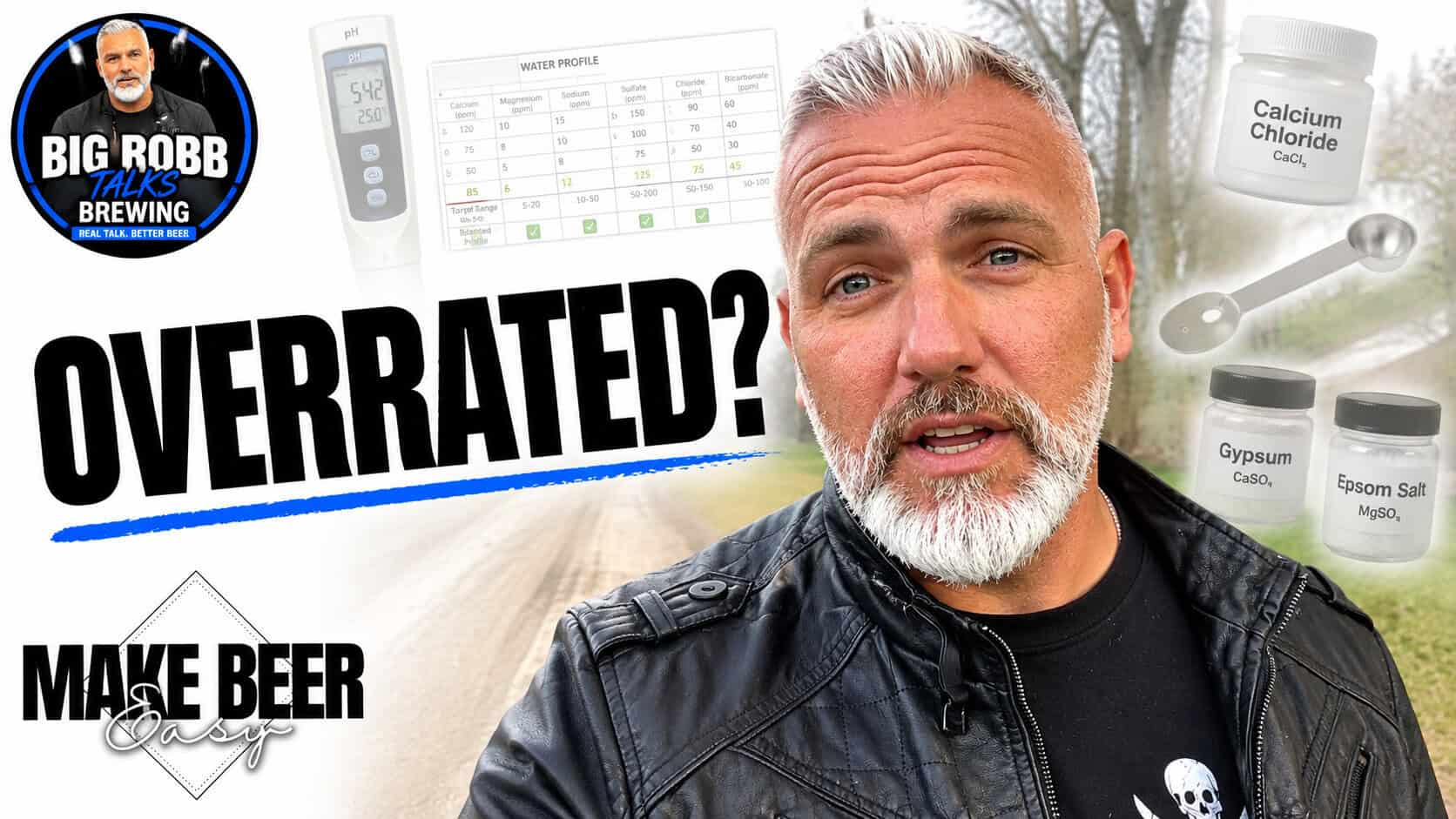
Have you ever gone looking for a simple answer about brewing…
…and twenty minutes later you’re reading about sulfate-to-chloride ratios, wondering if you need a chemistry degree just to make a decent beer?
Yeah. Me too. And honestly, most brewers I know have a version of that story.
Alright, pull up a stool, grab a beer, and let’s talk about the topic that scares off more new homebrewers than infected batches and stuck fermentations combined.
Water chemistry.
You’ve seen the posts. The spreadsheets. The guys in the Facebook groups arguing about sulfate-to-chloride ratios like it’s a religious debate, and getting weirdly heated about it, over beer, a hobby that’s supposed to be fun.
Here’s the thing though. If you’re new to this and you stumble into one of those threads, it’s easy to walk away thinking “well shoot, I guess I need a chemistry degree before I’m even allowed to brew a decent beer.”
I’ve watched it happen. New brewer asks a simple question, gets buried under mineral additions and pH targets, and just… disappears. Never posts again. Maybe never brews again either.
So let me save you that spiral right now.
You don’t need water chemistry to brew great beer. Not yet, anyway. And honestly, I think a lot of people are being handed the wrong lesson at the wrong time.
I’ve been brewing for a long time now, and only recently did I really dive deep into water chemistry myself.
Not because it suddenly became important. It was always important.
But because I finally reached the point in my own brewing where I knew improving my water would actually move the needle on my beer. Before that point? I promise you, tightening up my sanitation and getting my fermentation temps under control did more for my beer than any water adjustment ever could have.
That’s the whole article right there, honestly. But let’s actually dig into why.
Watch the Video
I actually sat down and talked through this exact topic on video, and I’ll be honest, some of this lands better when you can hear me explain the reasoning out loud instead of just reading it off a page. If you’ve ever felt that little pit in your stomach scrolling through a water chemistry thread, wondering if you’ve been doing it wrong this whole time, watch it. It’ll save you a headache.
(COMING SOON)!
Why This Question Even Comes Up In The First Place
Here’s what typically happens. A new brewer joins a homebrewing group looking for basic advice, something simple like “hey what temp should I ferment at,” and within about ten minutes somebody’s telling them to buy a pH meter, calculate their full water profile, and start dosing gypsum and calcium chloride before they’ve even brewed their second batch.
I get why it happens. Water nerds love talking about water. And look, I say that with love, because I’m one of them now.
It’s a genuinely fascinating subject once you’re deep into the hobby and chasing that last bit of polish on your beer. But when that conversation gets aimed at somebody who just wants to make a drinkable batch of pale ale in their garage, it does way more harm than good.
It makes brewing feel like a science exam instead of a hobby, and some folks quit before they ever get a single batch in the fermenter.
So let’s slow down and actually answer this the right way.
Yes, Water Chemistry Matters. I’m Not Going To Pretend Otherwise.
I’m not going to sit here and tell you water chemistry is a myth or a waste of time, because that would be lying to you, and that’s not how I do things around here.
Water makes up roughly 90% or more of your finished beer. Think about that for a second. Ninety percent of what’s in your glass is water. The mineral content of that water affects your mash pH, your enzyme activity, how sharp or soft your hop bitterness comes across, and the overall balance of the finished beer.
Brewers who dial in their water chemistry can absolutely make noticeably better beer. Sharper hop character in a West Coast IPA. Rounder, softer malt character in a stout. More consistency batch after batch, which honestly might be the biggest win of all.
This stuff is real, and I’m not here to talk anybody out of eventually learning it.
But here’s my opinion, and you can take it or leave it: the mistake isn’t caring about water chemistry. The mistake is treating it like a prerequisite instead of a refinement. It’s dessert, not the main course. And too many beginners are being told to eat dessert first.
If You’re Going To Spend Money Anywhere, Spend It Here
Before we go any further, let’s talk gear for a second, because this ties directly into the whole “priorities” conversation.
If you’re just getting into this hobby and staring down a wall of equipment options, here’s my honest take: don’t spend your first dollars on water testing kits, pH meters, and salt additions. Spend them on the stuff that actually determines whether your beer turns out drinkable in the first place.
If I were starting over today, I’d put every early dollar into a solid fermenter, a reliable thermometer, and good sanitizer before I’d even think about a water report. I put together my recommended all grain brewing equipment so you can see exactly what actually matters when you’re building your setup, instead of guessing based on whatever the loudest guy in the group is pushing this week.
The Fundamentals Have A Bigger Impact Than Water Chemistry. Full Stop.
Here’s the part nobody wants to say out loud in those water chemistry threads: if your sanitation is sloppy, your fermentation temperature is out of control, or your mash temp is off by ten degrees, no amount of gypsum is going to save that beer.
I don’t care how perfect your calcium-to-sulfate ratio is. That beer is getting drain poured either way.
Think about it like this. Water chemistry is like seasoning a steak. If you burn the steak, nobody cares how expensive the salt was. Doesn’t matter if it’s the fanciest salt in the world, if the meat’s charred and dry, you’re not tasting the seasoning, you’re tasting your mistake. Brewing works the same way. Fermentation is cooking the steak. Water chemistry is the seasoning. Get the cook right first.
I’ve talked to brewers who spent hours, and I mean hours, calculating the “perfect” water profile for a beer that ended up tasting like hot garbage because their fermentation chamber was sitting at 78°F in a hot garage the whole time.
The water was flawless. The beer wasn’t. Not even close. And that’s not a hypothetical, I’ve watched this exact scenario play out more times than I can count.
I’ve also watched brewers buy a pH meter before they owned a decent thermometer. Let that sink in for a second. A device that measures acidity down to the hundredth decimal point, before they had a reliable way to know if their mash was even in the right ballpark temperature-wise.
That’s backwards, and I completely understand why it happens, because the internet makes water chemistry look like the “advanced brewer” badge of honor. But it’s not the thing that’s holding your beer back. Not at this stage.
Let’s actually talk about what does move the needle when you’re starting out.
Sanitation
This is still, after all these years, the number one thing that separates good homebrew from bad homebrew. It’s not glamorous. Nobody’s writing spreadsheets about it or posting their sanitation routine for internet points.
But a poorly sanitized piece of equipment will wreck a batch faster than an unbalanced water profile ever will, and it’ll do it in a way that’s way harder to diagnose after the fact. If you haven’t nailed down your process yet, my guide on how to clean and sanitize your homebrewing equipment is a good place to tighten that up before you worry about anything else on this list.
Mash Temperature
Your mash temperature determines how fermentable your wort is, which directly affects your final gravity, your body, and your ABV. Miss this by a wide margin and it doesn’t matter what your calcium levels are, your beer is going to taste off, either too thin and boozy or too sweet and cloying.
If you want to actually understand what’s happening in that mash tun (or your BIAB bag, no judgment here), check out my breakdown on mashing temperatures.
Fermentation Temperature Control
Honestly, I’d put this above water chemistry every single time for a new brewer, and it’s not close.
Fermenting too hot creates fusel alcohols and harsh, boozy off-flavors that no amount of aging fixes. Fermenting too cold can stall your yeast completely and leave you with a stuck fermentation and a whole lot of frustration.
Getting this dialed in will improve your beer more than any single water addition you could make, and I’d bet money on that. If you want to understand exactly what’s happening in that fermenter and why temperature control matters so much, my guide on how to ferment beer walks through the whole process step by step.
Pitching Enough Healthy Yeast
An underpitched batch of beer is going to show stress characters, think harsh fusel notes and weird esters, no matter how perfect your water chemistry is. This is one of those unsexy fundamentals that quietly makes a massive difference and almost nobody talks about it in the beginner groups.
Learning how to properly pitch yeast, and building a yeast starter when your beer calls for it, will do more for your fermentation quality than a pH meter ever will.
See the pattern here? None of these require a spreadsheet. None of them require a chemistry background. They just require you paying attention to the basics and actually doing them consistently, batch after batch.
Brewing Is Supposed To Be Fun
You know what I’ve noticed? A lot of new brewers get so overwhelmed trying to learn everything before they brew anything that they forget why they picked up this hobby in the first place.
Brewing is supposed to be fun. It’s a hobby, not a certification program.
Somewhere along the way, a lot of folks convince themselves they need to master mash chemistry, yeast biology, and water treatment before they’re “allowed” to brew a batch that counts. Honestly, that’s backwards, and it sucks the joy right out of brew day.
Don’t let spreadsheets replace brew days. If you’re spending more Saturdays researching than actually brewing, something’s off. The hobby is supposed to smell like boiling wort, not look like a homework assignment.
Give yourself permission to be a beginner for a while. Make some average beer. Learn from it. Make it again, a little better. That’s the whole process, and honestly, it never really stops even after years of doing this.
Here’s the thing though, this ties into something bigger that I see constantly.
Plenty of brewers spend months researching before they ever brew a single batch. Watching YouTube videos. Reading forums until 1am. Comparing equipment specs. Studying water chemistry charts. All before they’ve turned on a single burner.
In my opinion, experience is still the greatest brewing teacher there is. You’ll learn more from one slightly flawed batch you actually brewed than from a hundred hours of research on a batch you never got around to making. So if you’ve been stuck in research mode, take that as your sign. Go brew another batch instead.
So When Does Water Chemistry Actually Become Worth Your Time?
Now don’t get me wrong, I’m not telling you to ignore water chemistry forever. There’s a real point where it starts paying off, and for me, that point came after years of brewing, not weeks.
Water chemistry starts earning its spot on your bench once you’ve already got the fundamentals locked in and you’re chasing that last 10-15% of improvement. This is usually somewhere after you’ve got a handful of solid batches under your belt and you’re starting to notice things like:
- Your hoppy beers taste a little flat or dull in bitterness even though your hop schedule and additions look solid on paper
- Your malty beers feel a bit harsh or minerally, almost chalky, even when everything else checks out
- You’re brewing the exact same recipe repeatedly and getting slightly inconsistent results batch to batch, and you can’t figure out why
- You’ve already got sanitation, fermentation temperature control, and yeast health completely locked in and you’re genuinely looking for the next level
That’s the point where learning about your local water report, and maybe starting with something as simple as understanding the role of gypsum in brewing, actually starts to move the needle instead of just being one more thing to worry about.
You Don’t Need To Buy Everything At Once
And to be clear, when you do get to that point, you don’t need to go buy a lab’s worth of equipment. A basic set of brewing salts and a decent pH meter will get you most of the way there for most beginner-to-intermediate water adjustments.
You don’t need lab-grade gear to make solid, noticeable improvements. Take a look at the all grain brewing equipment I recommend when it’s actually time to level up. It’s built around what real brewers actually use, not what looks impressive sitting on a shelf collecting dust.
What If Your Water Is Genuinely Bad?
Now don’t get me wrong, there’s one exception worth mentioning here, and I want to be honest about it instead of glossing over it.
If your tap water has a strong chlorine taste, high chloramine levels, or something else clearly off about it, that’s not really “water chemistry” in the advanced sense. That’s just a basic water quality problem, and it’ll hurt your beer no matter what stage you’re at in your brewing journey.
In that case, it’s worth addressing early, and the fix is usually dead simple. A Campden tablet handles chlorine and chloramine in about five minutes and costs next to nothing.
If your water source is genuinely rough, some brewers switch over to reverse osmosis water and build their water profile up from a clean baseline instead of fighting against whatever’s coming out of the tap. That’s a different situation than fine-tuning mineral ratios for a specific beer style, and honestly it’s worth sorting out regardless of how many batches you’ve brewed, because bad tap water will haunt every single beer you make until you deal with it.
My Honest Recommendation For Beginners
Honestly, if I were starting over today, here’s the order I’d actually focus on things, and I say this as somebody who did it in a different order and paid for it with some genuinely rough early batches:
- Nail your sanitation process every single time, no exceptions, no shortcuts
- Get comfortable with your mash temperature and process
- Control your fermentation temperature as best you can with the tools you’ve got
- Learn to pitch a healthy amount of yeast, and build a starter when the beer calls for it
- Brew several batches and actually get a feel for your process and your palate
- Then, and only then, start layering in water chemistry
Water chemistry isn’t step one. It’s not even step three. It’s the fine-tuning stage, and there’s absolutely nothing wrong with getting there eventually.
Just don’t let it stop you from brewing your next batch in the meantime. That’s the whole point of this article, honestly. Don’t let the advanced stuff paralyze you before you’ve even started.
If you want a full walkthrough of the entire process from start to finish so you’re not guessing at any of these steps, my complete guide to homebrewing covers exactly that from the ground up.
And if you want a broader list of the little things that make a real difference early on, things I wish somebody had told me when I started, I put together a list of 21 homebrewing tips that covers a lot of this same ground.
Join The Free Beginner Homebrewing Bootcamp
If you’re just getting started and want a clear roadmap instead of trying to piece everything together from random forum posts and conflicting advice, my free Beginner Homebrewing Bootcamp walks you through the fundamentals in order. Sanitation, fermentation, and everything else that actually matters before you ever need to think about water chemistry. It’s free, it’s simple, and it’ll save you from a lot of the mistakes I made early on in my own brewing.
Beer Recipe Newsletter
If you’ve already got a batch or two under your belt and you’re past the fundamentals, my Beer Recipe Newsletter is where I share the recipes that actually worked out at my brewpub, along with the process tweaks, water adjustments, and small details that took my beer from good to something people kept coming back for pint after pint. It’s built for brewers who are ready to start refining, not starting from scratch.
Frequently Asked Questions
Do beginners need water chemistry?
No. Beginners get far more value out of nailing sanitation, mash temperature, fermentation control, and yeast health. Water chemistry becomes useful once those fundamentals are already solid and you’re chasing smaller, more specific improvements.
Do I need a pH meter?
Not right away. A pH meter is a helpful tool once you’re refining your process, but it’s not a requirement for brewing good beer as a beginner. Most municipal water sources are perfectly fine for early batches, and I’d rather see you spend that money on a good thermometer first.
Can water chemistry improve beer?
Yes, genuinely. Adjusting mineral content can sharpen hop bitterness, round out malt character, and improve consistency batch to batch. It’s a real and valuable tool, just not the first one you need to reach for.
Should I adjust every batch?
Not necessarily. Some brewers adjust water for every recipe, others only adjust for specific styles where it makes a noticeable difference, like hop-forward IPAs or mineral-heavy stouts. There’s no rule that says you have to adjust every single batch, and in my opinion, chasing that can suck the fun out of brewing if you let it.
When should I start learning water chemistry?
Once you’ve brewed several batches, feel confident in your sanitation and fermentation process, and you’re chasing small, specific improvements in your beer. That’s usually the point where water chemistry starts to actually matter for your results instead of just being one more thing competing for your attention.
Alright, Give Yourself Permission Here
If you’ve been putting off your next brew day because you’re worried you don’t understand water chemistry yet…
Stop.
Seriously, stop right there.
Brew the beer. Learn from it. Have fun with it, because that’s the entire point of this hobby in the first place. Water chemistry will still be waiting for you six months from now, patiently, not going anywhere, not expiring.
In my opinion, the brewers who improve the fastest aren’t the ones with the most spreadsheets. They’re the ones who just keep brewing, paying attention, and adjusting one thing at a time.
The Bottom Line
Water chemistry is a real, valuable tool. It’s just not the tool that’s going to make or break your first ten batches, and I don’t think it should be the first thing anybody tells a new brewer to worry about.
Get your fundamentals locked in first. Brew a lot. Pay attention to what you’re actually tasting in the glass, not what a spreadsheet says you should be tasting.
Brewing isn’t about chasing perfection. It’s about making beer you’re proud to share with your buddies, your family, or that one neighbor who always seems to show up right when you’re bottling.
Master one thing at a time. Keep brewing. Keep learning. The water stuff will still be there waiting for you when you’re ready for it.
Here’s something I remind myself of pretty often, and I’ll leave you with it too:
If this article gives you permission to stop worrying about water chemistry for a while…
Good.
That’s exactly what I hoped it would do.
Great beer isn’t brewed by people who know everything. It’s brewed by people who keep brewing.
You don’t need to master everything today.
You just need to brew another batch.
Continue Learning
If you’re ready to keep improving, these are the next articles I’d recommend reading, roughly in the order I’d read them myself, each one builds on the last:
- How to Homebrew – The Complete Guide
- How to Clean & Sanitize Homebrewing Equipment
- How to Ferment Beer – 5 Steps Explained
- The Ultimate Guide to Fermentation Temperatures
- Introduction to Mashing Temperatures
- How to Pitch Yeast
- How to Make a Yeast Starter
- 21 Homebrewing Tips
- Using Reverse Osmosis Water in Making Beer
- The Role of Gypsum in Brewing
- pH of Beer Explained
Equipment I Recommend
FREE Beginner Homebrewing Bootcamp
New to brewing and don’t want to waste money or ruin batches figuring it out the hard way? Join the free Beginner Homebrewing Bootcamp and I’ll walk you through the fundamentals step by step, no fluff, no unnecessary gear, just what actually works.
👉 Join the Beginner Brewing Bootcamp
Beer Recipe Newsletter
Ready to start refining your beer instead of just getting it done? Grab my top 5 best-selling brewpub recipes and get on the list for more recipes and process tips as they come out.
👉 Get My Top 5 Brew Pub Recipes
Watch the Video
If you want to hear this whole topic talked through in more detail, including a few stories from batches where I learned this lesson the hard way, check out the video below.
COMING SOON!
When I first started brewing, someone told me that if the water is good enough to drink, it’s good enough for brewing. I noticed that the chlorine in our water leaves an off-flavor, so I found a way to deal with it. I fill my brewing vessels with water and let them sit for ~12 hours. Chlorine is a gas, and it will evaporate. I just leave it set d for twelve hours, and I’m good to go
You got it Dave, that is the easiest way to handle city water that has chlorine. Appreciate the comment, and cheers to you sir!