
Have you ever walked into your local homebrew shop with your recipe in hand only to discover they’re out of one of the ingredients you need?
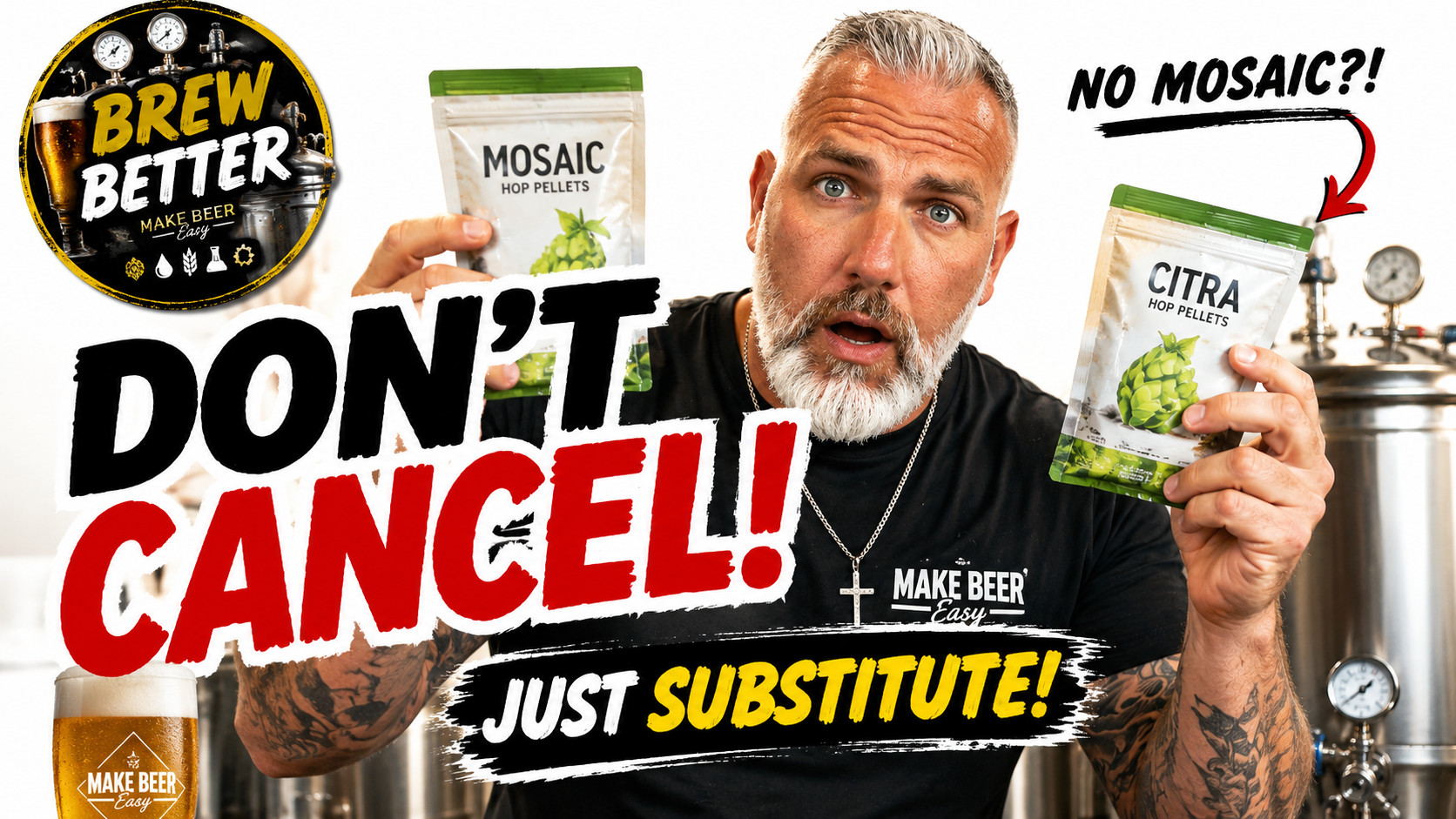
Maybe your recipe calls for Mosaic hops, but they’re sold out.
Maybe they don’t have the exact yeast strain.
Or perhaps the grain you planned to use isn’t available.
For many homebrewers, that’s enough to postpone brew day.
Don’t.
One of the biggest lessons I’ve learned over the years is that recipes are guides, not rules. Experienced brewers substitute ingredients all the time, and once you understand what each ingredient contributes to your beer, you’ll realize that one missing ingredient should never stop you from brewing.
Why You Shouldn’t Cancel Brew Day
Years ago, I probably would have.
If my recipe called for Mosaic hops and the shop didn’t have them, I’d simply wait until they came back in stock.
Looking back, that was a mistake.
The reality is that beer recipes are built around flavours, aromas, bitterness, colour, body, and fermentation characteristics. There is often more than one ingredient capable of achieving a very similar result.
Will your beer be identical?
Probably not.
Will it still be excellent?
Very likely.
Some of my favourite batches have come from making substitutions I hadn’t planned.
Understanding Hop Substitutions
Hops are probably the ingredient homebrewers worry about substituting the most.
The secret is to think about why that hop was included in the recipe.
Is it there primarily for bitterness?
Is it contributing flavour?
Is it used as a late addition for aroma?
Is it being used as a dry hop?
For example, while brewing my Tropical Thunder Blonde Ale, my recipe called for Mosaic hops.
No Mosaic.
No problem.
I substituted with Citra because it provides a similar tropical fruit character and works beautifully in the style.
Would I notice a slight difference if I tasted them side by side?
Probably.
Would ninety-nine percent of people drinking the beer?
Probably not.
The important thing is understanding what you’re trying to achieve rather than blindly following a recipe.
Grain Substitutions Are Easier Than Most Brewers Think
The same idea applies to malt.
Most base malts can be substituted with another similar base malt with very little impact on the finished beer.
Specialty malts require a little more thought because they contribute colour, sweetness, roast character, or body, but there are still many excellent alternatives available.
If your local shop is out of one crystal malt, there is often another that will produce a very similar result.
Learning these relationships makes recipe design much less intimidating.
Don’t Be Afraid To Substitute Yeast
Yeast is another ingredient that scares newer brewers.
Many recipes call for one very specific yeast strain, making it sound like that’s the only option.
It isn’t.
Many yeast strains produce similar attenuation, flocculation, and flavour profiles.
If your preferred strain isn’t available, choosing another strain with similar characteristics will usually produce an outstanding beer.
The yeast might change the final beer slightly, but that’s part of the fun of homebrewing.
Every batch teaches you something.
Learn What Ingredients Actually Do
One of the biggest differences between beginner brewers and experienced brewers is how they think.
Beginners often ask:
“What ingredient does this recipe call for?”
Experienced brewers ask:
“What job is this ingredient doing?”
That’s the mindset shift that changes everything.
Once you understand the purpose of each ingredient, substitutions become much easier and brewing becomes much more enjoyable.
Build a Brewery That Gives You More Flexibility
One thing I’ve learned over the years is that having the right equipment and a few commonly used ingredients on hand makes brew day much less stressful.
I keep a small inventory of my favourite hops, a few reliable yeast strains, and some staple grains so I can adapt recipes whenever I need to.
If you’re still building your brewery, check out my recommended brewing equipment. I’ve put together buying guides for beginners, intermediate brewers, and advanced homebrewers, along with the equipment I personally recommend.
👉 Recommended Brewing Equipment
Free Homebrewing Substitution Charts
To make life easier, I’ve put together free substitution charts covering the three ingredients homebrewers ask about most:
Instead of searching forums every time your local shop is out of something, simply bookmark the charts and use them whenever you need them.
They’re designed to help you make confident substitutions without the guesswork.
Store Ingredients Properly
One of the easiest ways to avoid cancelling brew day is to keep a few staple ingredients on hand.
Vacuum-sealed hops stored cold will stay fresh for months, and properly stored yeast gives you much more flexibility when your local homebrew shop is out of stock.
If you’re planning to keg your beer or you’re looking at setting up a dedicated beer fridge, check out my complete kegging and kegerator equipment guide. It’s the same type of equipment I recommend to anyone looking to take their home brewery to the next level.
👉 Kegging & Kegerator Equipment
Don’t Chase Perfection
One of the biggest reasons new brewers become frustrated is because they think every recipe must be followed perfectly.
It doesn’t.
Homebrewing is supposed to be fun.
If you’re constantly stressing because one ingredient isn’t available, you’re missing one of the best parts of the hobby.
Adapt.
Experiment.
Learn.
Some of the best beers I’ve ever brewed happened because I was forced to make a substitution.
The Bottom Line
If your local homebrew shop is out of an ingredient, don’t cancel brew day.
Learn what each ingredient contributes.
Understand the role it plays in the recipe.
Use a suitable substitute.
Then brew the beer.
You’ll become a better brewer, you’ll gain confidence, and you may even discover a combination you like better than the original recipe.
One missing ingredient shouldn’t stop you from enjoying one of the greatest hobbies in the world.
So the next time your recipe calls for Mosaic hops and your homebrew shop is sold out…
Brew anyway.
You might just create your new favourite beer.
Watch the Video
(coming soon)
In the accompanying video, I walk through this exact situation while brewing my Tropical Thunder Blonde Ale. I explain why I substituted Mosaic hops, how I made the decision, and why understanding ingredients will make you a much more confident homebrewer.
Ready To Brew Better?
If you’re just getting started, be sure to join my free Beginner Brewing Bootcamp, where I’ll walk you through the brewing process step by step.
You can also download my Top 5 Best-Selling Brew Pub Recipes, bookmark my Free Homebrewing Tools, and check out my Recommended Brewing Equipment if you’re looking to upgrade your brewery.
Cheers,
Big Robb
Make Beer Easy
Simple brewing. Better beer.