
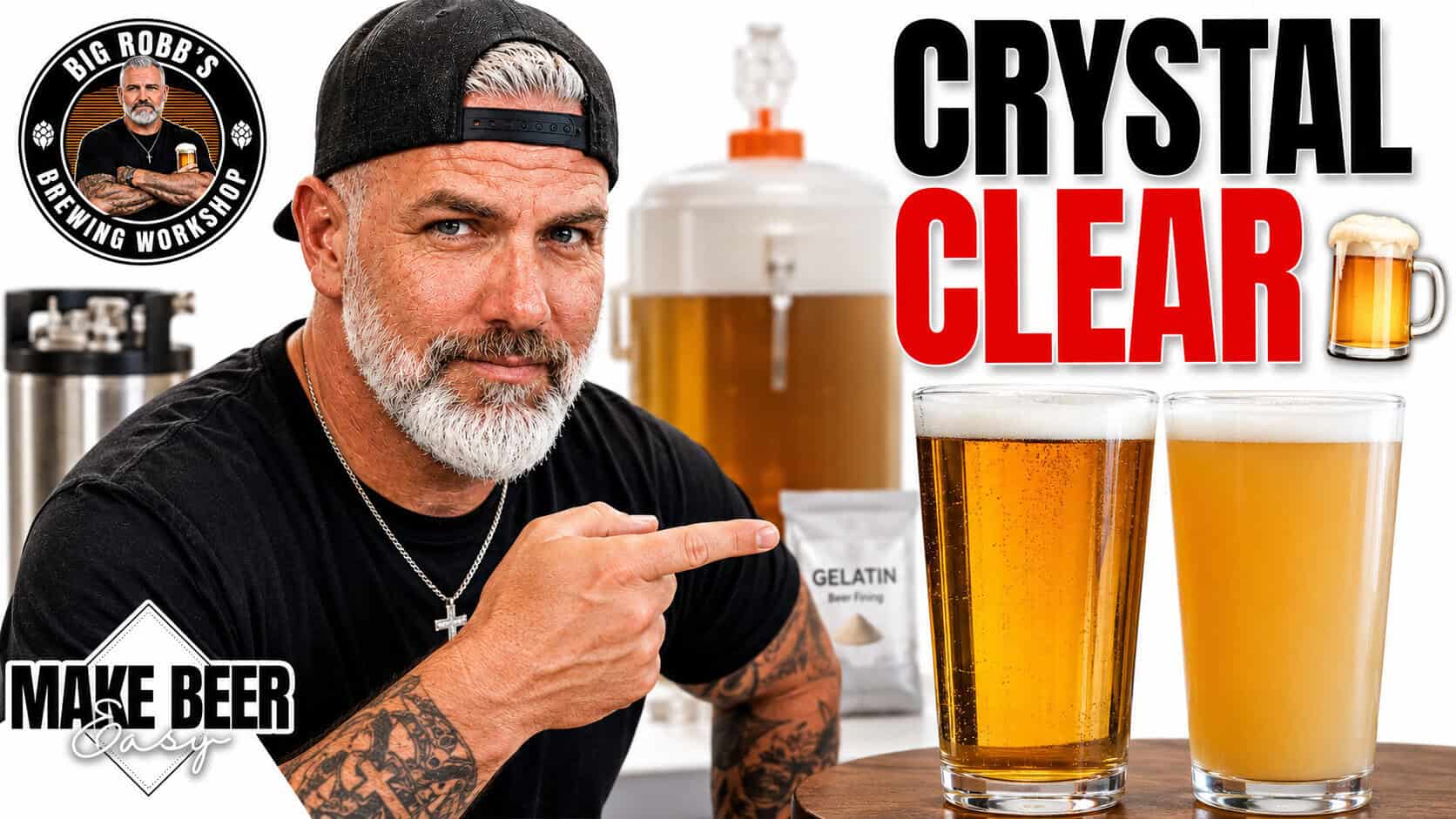
If you’ve ever poured one of your homebrews and thought…
“Man, I wish this beer was a little clearer…”
You’re not alone.
One of the biggest things new homebrewers notice when they compare their beer to commercial beer is clarity. The beer tastes great, smells great, but it still has a bit of haze floating around in the glass.
The good news?
Getting crystal clear beer is actually much easier than most people think.
One of the simplest techniques I use is gelatin fining.
It takes only a few minutes, costs next to nothing, and can make a dramatic difference in how your finished beer looks.
Better yet…
You don’t need expensive equipment or years of brewing experience.
In this guide I’ll walk you through exactly how I gelatin fine my beer, when to do it, why it works, and the mistakes you should avoid.
🎥 Watch the Video
What Is Gelatin Fining?
Gelatin fining is a simple process that helps pull unwanted particles out of your beer.
Those particles include things like:
- Yeast
- Protein haze
- Polyphenols
- Small bits of hops
- Other suspended material
Gelatin is positively charged.
Most of the haze-causing particles floating around in your beer carry a negative charge.
When you add gelatin to cold beer, those particles stick together, become heavier, and eventually fall to the bottom of the fermenter.
The result?
A much clearer beer.
It’s really that simple.
Why Should You Gelatin Fine Your Beer?
Now before we go any further…
Let’s get something straight.
You don’t have to gelatin fine beer.
Plenty of fantastic beers are naturally hazy.
New England IPAs are a perfect example.
But if you’re brewing beers like:
A bright, crystal-clear pint really improves the presentation.
And let’s be honest…
We eat—and drink—with our eyes first.
When someone sees a beautiful clear pint sitting on the table, they immediately think:
“That looks professional.”
When Should You Add Gelatin?
Timing is everything.
Adding gelatin too early won’t help much.
I always recommend waiting until fermentation is completely finished.
Once fermentation is done:
- Cold crash the beer.
- Hold it cold for about 24–48 hours.
- Then add the gelatin.
The colder the beer is, the better gelatin works.
Personally, I like to have my beer sitting around refrigerator temperature before adding it.
Why Cold Crashing Matters
Cold crashing already helps clear beer.
As the temperature drops, yeast naturally begins settling to the bottom.
Adding gelatin after cold crashing speeds that process up even more.
Think of it as giving gravity a helping hand.
If you’ve never cold crashed before, I highly recommend learning the process. It’s one of the easiest ways to improve the appearance of your beer.
Need a simple way to control fermentation and cold-crash your beer?
👉 See My Fermentation & Temperature Control Equipment
How Much Gelatin Do You Need?
One of the biggest mistakes beginners make is thinking:
“If a little works…
…more must work better.”
Not true.
For most 5-gallon batches, you’ll only need about 1 teaspoon of unflavored gelatin.
For smaller batches, scale that amount down.
For example:
- 1 gallon → about ¼ teaspoon
- 2.5 gallons → about ½ teaspoon
- 5 gallons → about 1 teaspoon
You don’t need much.
🛠️Recommended Brewing Equipment
If you’re looking for the brewing equipment I personally recommend—including measuring spoons, thermometers, fermenters, and more—check out the Make Beer Easy Equipment Hub.
Step-by-Step: How to Gelatin Fine Beer
Here’s exactly how I do it.
Step 1 — Sanitize Everything
Anything touching your beer needs to be sanitized.
That includes:
- Spoon
- Measuring cup
- Funnel (if using one)
- Anything entering the fermenter
Sanitation is always priority number one.
If you’re new to brewing, spend the extra few minutes here.
It’s worth it.
Step 2 — Prepare the Gelatin
Measure the correct amount of unflavored gelatin.
Add it to a small amount of cool water.
Allow it to bloom for several minutes.
This helps the gelatin hydrate properly before heating.
Step 3 — Heat the Mixture
Now gently heat the mixture.
Notice I said…
Gently.
You do not want to boil it.
I usually heat it until it’s hot enough to completely dissolve the gelatin.
Once it’s clear and fully dissolved, it’s ready.
Step 4 — Add It to the Beer
Open your fermenter carefully.
Pour the gelatin solution into the cold beer.
Try not to splash.
You’re not trying to aerate the beer.
You’re simply adding the fining agent.
Close the fermenter back up.
That’s it.
Seriously.
The hard part is already done.
How Long Does It Take?
One of the questions I get all the time is:
“How long before I see results?”
Usually…
Pretty quickly.
Many brewers begin seeing dramatically improved clarity within 24 to 72 hours.
Personally, I like giving it about three days before packaging.
That gives everything plenty of time to settle.
Common Mistakes to Avoid
Here are the biggest mistakes I see beginners make.
Adding Gelatin Before Fermentation Is Finished
Don’t do it.
Wait until fermentation is complete.
If you’re unsure whether your beer is finished fermenting, grab your hydrometer and verify your final gravity before moving on.
Using Boiling Water
Boiling isn’t necessary.
Gentle heat is all you need.
Skipping the Cold Crash
Can gelatin still work?
Yes.
Will it work as well?
Usually not.
Cold beer allows gelatin to do its best work.
Adding Too Much
More gelatin does not equal clearer beer.
Use the recommended amount.
Will Gelatin Affect the Taste?
No.
Not in any noticeable way.
Gelatin doesn’t make your beer taste different.
It simply helps remove particles that would otherwise remain suspended in the beer.
The flavour stays exactly where you want it.
Only the haze disappears.
Other Ways to Clear Your Beer
While gelatin fining is one of my favourite methods, it’s certainly not the only way to produce crystal clear beer.
Depending on the style you’re brewing and your brewing process, you may not need gelatin at all.
Here are a few other options.
Time
Honestly, time is one of the best fining agents available.
Many beers will naturally clear if you simply leave them in the fermenter a little longer.
Patience costs nothing.
Cold Crashing
As we talked about earlier, cold crashing encourages yeast and proteins to settle out of suspension.
For many beers, cold crashing alone is enough to produce excellent clarity.
Kettle Finings
Products like Whirlfloc and Irish Moss are added during the boil.
They help coagulate proteins before fermentation even begins.
They’re inexpensive, easy to use, and work very well alongside gelatin fining.
Good Brewing Practices
Sometimes cloudy beer isn’t caused by a lack of fining agents.
It’s caused by poor brewing practices.
Simple things like:
- Maintaining proper fermentation temperatures
- Avoiding unnecessary splashing
- Giving yeast enough time to finish
- Leaving trub behind when transferring
can dramatically improve clarity before you ever think about adding gelatin.
7 Ways To Clear Beer: In this post, I provide my top 7 favourite ways to clear beer
Does Every Beer Need to Be Crystal Clear?
Absolutely not.
This is something I think gets overlooked far too often.
Some beer styles are supposed to be hazy.
For example:
- New England IPA
- Hefeweizen
- Witbier
Trying to make those beers crystal clear actually works against the style.
So don’t chase clarity just because you think every beer should look like a commercial lager.
Ask yourself:
What style am I brewing?
If it’s a hazy style…
Embrace the haze.
If it’s a Blonde Ale, Cream Ale, Pilsner, or Lager…
That’s where gelatin fining really shines.
My Personal Thoughts
If you’ve watched my channel for any length of time, you already know my philosophy.
I’m not interested in making homebrewing more complicated than it needs to be.
I’m interested in making better beer.
Gelatin fining is one of those rare techniques that’s:
- Cheap
- Easy
- Beginner friendly
- Highly effective
That’s a pretty good combination.
If you’re looking for one simple upgrade that makes your finished beer look significantly more professional, I’d put gelatin fining very high on the list.
Continue Learning
If you’re enjoying this guide, here are a few more beginner-friendly brewing guides that pair well with gelatin fining:
- 👉 How to Bottle Beer
- 👉 How to Keg Beer
- 👉 How to Use a Hydrometer
- 👉 How to Sanitize Brewing Equipment
🛠️Recommended Brewing Equipment
If you’re looking to improve your brewing setup, check out the Make Beer Easy Equipment Hub, where I’ve put together the brewing equipment I personally recommend for beginners.
Whether you’re looking for fermenters, kettles, kegging equipment, measuring tools, or cleaning supplies, you’ll find everything organized in one place.
Equipment Used
For this process I typically use:
- Unflavoured gelatin
- Small measuring spoons
- Digital thermometer
- Small saucepan or microwave-safe cup
- Sanitizer
- Fermenter
- Bottling or kegging equipment
👉 See my recommended equipment here: Make Beer Easy Equipment Hub
🍺 FREE Beginner Brewing Bootcamp
If you’re brand new to homebrewing—or you just want to become a more confident brewer—I created something specifically for you.
The FREE Beginner Brewing Bootcamp walks you through the brewing process step by step in plain English, helping you avoid the mistakes that cause so many new brewers to quit.
👉 Join the FREE Beginner Brewing Bootcamp
🍺 FREE Brew Pub Recipe Collection
Want to brew recipes that were actually served in my own brew pub?
I’ve put together my Top 5 Best-Selling Brew Pub Recipes, and they’re completely free.
These are recipes I’ve brewed, served, and enjoyed for years.
👉 Download your FREE recipe collection
Frequently Asked Questions
Can I gelatin fine beer before fermentation is finished?
No.
Always wait until fermentation has completely finished before adding gelatin.
Do I have to cold crash first?
Technically, no.
But gelatin works much better when the beer is cold, so I highly recommend cold crashing first.
Will gelatin remove flavour?
No.
It removes suspended particles—not flavour.
Your beer will taste the same, but it will usually look much clearer.
Can I use gelatin in every beer?
You can, but I wouldn’t.
Styles like New England IPAs, Hefeweizens, and Witbiers are naturally hazy and don’t necessarily benefit from gelatin fining.
Can I bottle after gelatin fining?
Absolutely.
Just give the gelatin enough time to settle everything to the bottom before bottling or kegging.
I usually wait around 48–72 hours.
Is gelatin safe for vegetarians?
No.
Gelatin is made from animal collagen.
If you’re looking for a vegetarian-friendly alternative, products like Biofine Clear are worth considering.
Final Thoughts
If you’re looking for one of the easiest ways to improve the appearance of your homebrew, gelatin fining is hard to beat.
It’s inexpensive.
It’s beginner friendly.
It only takes a few minutes.
And the results can be dramatic.
Remember, though…
Crystal clear beer doesn’t automatically mean better beer.
Taste always comes first.
But if you can brew a beer that tastes fantastic and pours bright and clear?
That’s a pretty satisfying feeling.
I’d Love to Hear From You
Do you gelatin fine your beer?
Have you tried another method that works well?
Leave a comment below and let me know.
I read every comment, and your experiences often help other brewers in the Make Beer Easy community.
Cheers,
Big Robb 🍻