
Homebrewing has one little problem nobody talks about much when you first get into the hobby.
You eventually become really good at making beer.
And then you have beer everywhere. 😂
A keg in the fridge.
Another batch fermenting.
A case of bottles downstairs.
Maybe another beer you’re already planning to brew next weekend.
That sounds like heaven when you first start homebrewing.
And honestly, it kind of is.
But it also creates something most people buying six-packs at the liquor store don’t have:
an almost unlimited supply of cheap beer sitting a few feet away.
I talked about that in my video Homebrewing Made Me Drink Too Much, where I told the story about admitting to my doctor that at one point I was drinking somewhere around 30–40 beers a week.
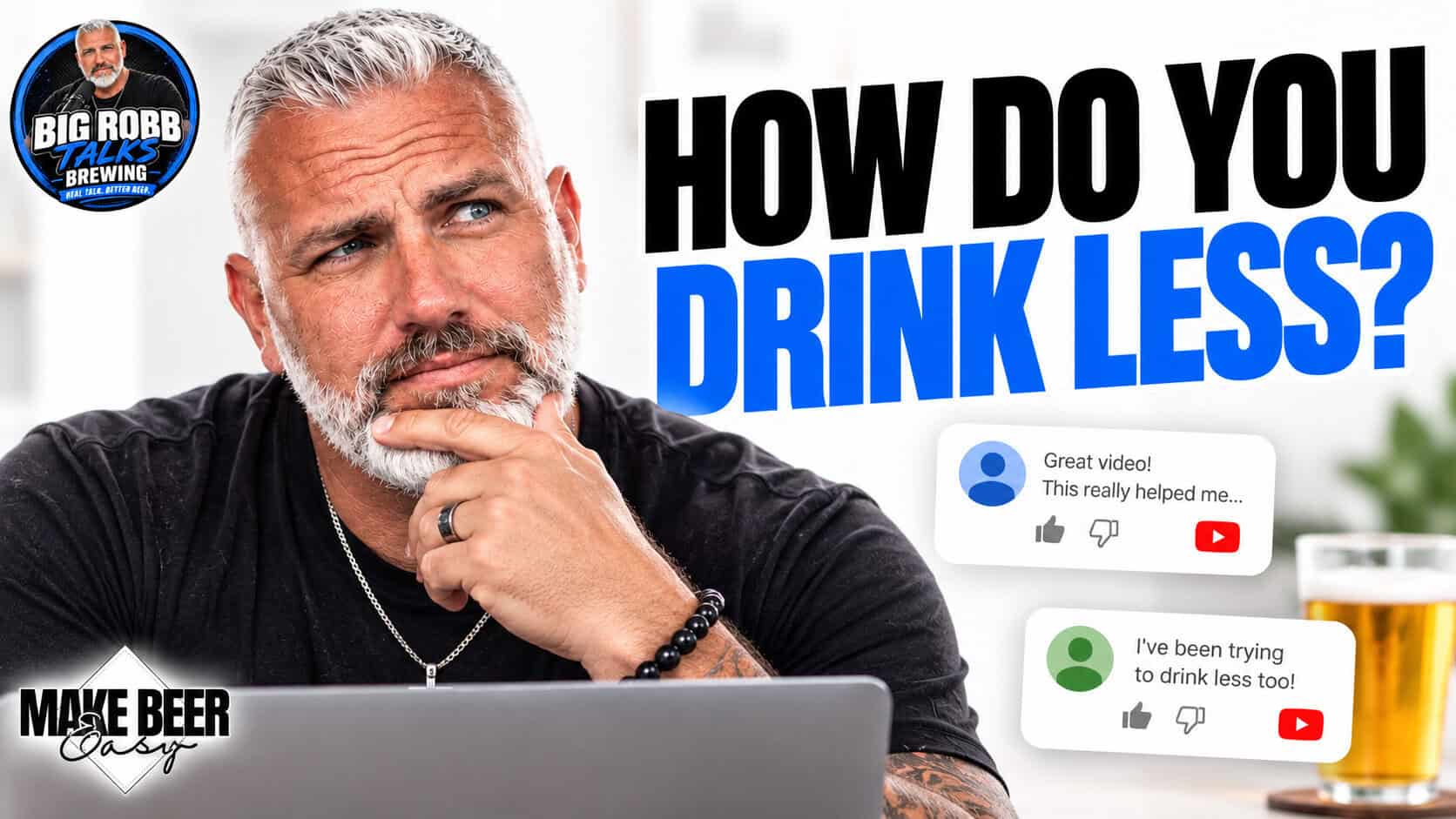
That video took off, and the comments underneath it turned into one of the most interesting conversations we’ve had on Make Beer Easy.
Homebrewers started sharing what THEY do to keep the hobby from slowly turning into drinking more than they intended.
Some of the ideas were simple.
Some were surprisingly smart.
And a few made me think, Why the hell haven’t I been doing that?
So this article is not about telling anybody they need to quit drinking.
It’s not anti-beer.
Hell, this is Make Beer Easy. I obviously still like beer. 😂
This is about one simple question:
How do you keep enjoying homebrewing without feeling like you need to drink everything you make?
Here are some of the best strategies real homebrewers shared, plus a few thoughts on why they can work.
This article is about personal experience and practical habits, not medical advice. Public-health guidance is clear that less alcohol generally means lower health risk. If you are concerned about your drinking, talk with a healthcare professional. If you have been drinking heavily for a prolonged period, suddenly stopping can cause dangerous withdrawal and medical guidance may be needed.
VIDEO: Homebrewers Told Me How They Drink Less… Here’s What They Said
Why Homebrewing Can Make It Easy to Drink More
Before we get into the strategies, I think we need to understand the problem.
Homebrewing itself doesn’t force anybody to drink.
Obviously.
But it changes your environment.
Beer Is Always Available
If you have a keg sitting ten feet away, getting another beer requires almost no effort.
You don’t have to drive anywhere.
You don’t have to spend more money.
You don’t even have to open another bottle.
You walk over, pull the tap and away you go.
That convenience is one of the reasons I love kegging.
It can also be the problem.
Homebrew Is Cheap
Once you already own your brewing equipment, the cost per pint can be a hell of a lot lower than buying craft beer at a bar or store.
That is fantastic for the hobby.
But price is one of the normal barriers that can slow somebody down.
When that barrier disappears, so can some of the natural limits.
Kegs Hide How Much You Have Drunk
This is a big one for me.
If I drink six bottles, there are six empty bottles sitting there.
Pretty obvious.
With a keg, you pour a pint.
Then maybe top it off.
Then another one.
Then perhaps another little top-up.
Eventually you’re wondering why the keg feels suspiciously light.
If you’ve never actually worked out the amount of beer sitting inside your keg, check out my guide on how many beers are in a keg.
Five gallons is a lot of damn beer.
Strategy #1: Decide Your Limit Before You Start Drinking
This was one of the most common ideas in the comments.
Several homebrewers had some version of:
“I decide how many I’m having before I start.”
Three beers was a popular number.
I like the basic thinking behind this.
Because beer number one is usually a pretty reasonable guy.
Beer number two isn’t too bad either.
By the time you start negotiating with yourself later in the evening, your decision-making may not be quite as impressive. 😂
That’s how you end up meeting what I affectionately call:
the slippery seventh beer.
The exact number is going to be different for different people.
The more important idea is making the decision before drinking, rather than continually asking yourself:
“Do I want another one?”
Because the answer to that question has an annoying habit of being yes.
Public-health resources aimed at helping people cut back also commonly recommend setting a limit in advance and keeping track of what you actually drink.
Make the Rule Simple
Complicated rules are hard to follow.
Something like this is easier:
- Maximum number of drinks
- Maximum number of drinking days
- No automatic refills
- Stop at a certain time
You don’t need seventeen rules.
You need rules you’ll actually remember after beer number two.
Strategy #2: Have Alcohol-Free Days
Another really common approach was simply:
Don’t drink every day.
Some homebrewers said they only drink Friday and Saturday.
Others had one or two designated alcohol-free days each week.
Some drink only when they’re out with friends.
The specific schedule matters less than creating days when opening a beer isn’t simply the default evening routine.
That distinction is important.
There’s a difference between:
“I decided to have a beer.”
and:
“It’s 6:30, so apparently we’re drinking beer.”
Scheduling alcohol-free days is also one of the practical approaches suggested by public-health programs designed to help people reduce drinking.
Strategy #3: Use a Smaller Glass
This one is almost stupidly simple.
And I like simple.
One commenter said he switched from full pints to roughly 13-ounce pours.
Same beer.
Same keg.
Smaller serving.
When I owned the brewpub, a lot of the beer I drank was coming in 20-ounce pints.
That’s a very different amount of beer from somebody drinking a smaller bottle or glass.
Which brings us to something homebrewers should pay more attention to:
A “Beer” Is Not Always a Beer
Saying:
“I had three beers.”
doesn’t tell us very much.
Were they small bottles of 4% session ale?
Or giant pints of an 8% double IPA?
Those are completely different amounts of alcohol.
As homebrewers, we have an advantage because we can actually measure the strength of what we’re making.
If you aren’t already doing it, learn how to calculate the ABV of your homebrew.
Knowing what is in the glass makes it much easier to make an informed decision about how much you’re drinking.
Strategy #4: Brew Smaller Batches
This might be my favorite homebrewing-specific strategy.
A bunch of guys essentially said:
“I enjoy brewing more than I enjoy drinking, so I stopped making so damn much beer.”
That’s brilliant.
Homebrewers often get conditioned to think five gallons is somehow the standard minimum batch.
It isn’t.
You can brew:
- 1 gallon
- 2 gallons
- 2.5 gallons
- 3 gallons
- whatever damn size works for you
One homebrewer in the comments had moved from 10-gallon batches back to five.
Another mostly makes three gallons.
Some make one-gallon experimental batches.
Why make 50 bottles of something when what you really wanted was the experience of creating the recipe?
Smaller Batches Let You Brew More Often
That’s the beautiful part.
If you love brewing, reducing batch size doesn’t necessarily reduce the hobby.
It can do the opposite.
Instead of brewing five gallons and waiting months to finish it, you can make smaller batches and try more recipes.
You get more brew days.
More experimentation.
More styles.
Less pressure to consume inventory.
That is a win in my book.
🛠️ Build a Brewing Setup Around How You Actually Brew
If smaller batches make more sense for you, don’t feel like you need the biggest, shiniest brewing system on the internet.
Buy equipment that matches the amount of beer you actually want to make.
I keep the brewing gear I recommend organized on my Recommended Brewing Equipment page.
Start with the brewing you actually plan to do and build from there.
Don’t buy a small commercial brewery because some guy on YouTube told you that’s what “serious brewers” use.
Strategy #5: Brew More Lower-ABV Beer
This came up over and over.
Homebrewers were talking about:
- 3.5% Kölsch
- session ales
- lower-strength pale ales
- keeping most beer below 5–6%
- brewing small amounts of big beer and larger amounts of small beer
And this is where being a homebrewer becomes an advantage.
You control the recipe.
You don’t have to make every IPA 8%.
You don’t have to make every stout 10%.
There are some fantastic beers in the 3–5% range.
English bitters.
Milds.
Kölsch.
Table beers.
Session pale ales.
Lower-gravity lagers.
You can still have malt.
You can still have hops.
You can still have flavour.
You’re simply designing the beer around drinkability instead of trying to win an alcohol arms race.
Big Beers Don’t Need Big Batches
If you want to make a 10% barley wine, go nuts.
But maybe you don’t need five gallons of it.
Make a small batch.
Bottle it.
Let it age.
Then brew something lighter for the beer you keep around regularly.
That’s a much different approach than keeping five gallons of double IPA connected to the tap beside your chair.
Strategy #6: Give Your Homebrew Away
This was another popular one.
One guy basically said:
“I give most of mine away.”
Simple.
Effective.
And personally, I’ve been doing a lot more of this too.
There is no rule saying the brewer has to personally drink the entire batch.
Your friends can help.
Your family can help.
Your homebrew club can help.
Bring some to a get-together.
Fill a growler for somebody.
Have friends bring the growler back and refill it next time.
The important part is changing the thought:
“I brewed this, therefore I have to drink it.”
No you don’t.
You brewed it because you enjoy making beer.
Seeing somebody else enjoy your beer can be one of the best parts of the hobby.
Just follow the alcohol-sharing and transport laws where you live, and never serve alcohol to somebody who’s already had too much.
Strategy #7: Consider Bottling Some of Your Beer
I’m a kegging guy.
I love kegging.
It’s easier.
It’s faster.
And pulling your own pint from a tap is pretty damn cool.
But bottling does have one advantage when you’re trying to keep track of consumption:
Every bottle is a defined serving.
You open one.
You drink it.
The empty bottle is sitting there.
There’s no:
“I’ll just top this glass up a little.”
Followed by four mysterious top-ups.
If you want to learn the process, here’s my complete guide to bottling homebrew beer.
And if you’re firmly on Team Keg—and I don’t blame you—you can check out my complete guide to kegging homebrew.
You don’t have to choose one forever either.
Bottle some beers.
Keg others.
For stronger beers especially, bottling can make a hell of a lot of sense.
🍺 Kegging or Bottling? Build the Setup That Works for You
If you’re setting up your packaging system, I’ve put my recommended gear together in the Make Beer Easy Kegging & Botting Equipment section.
Go through Make Beer Easy first rather than randomly buying whatever Amazon decides to shove in front of you.
Strategy #8: Stop Treating an Empty Keg as a Brewing Emergency
Homebrewers are funny.
We say:
“Oh shit, the keg is getting low. Better brew.”
Why?
Is there some government requirement that every tap in the house remain operational twenty-four hours a day? 😂
Sometimes an empty keg can just be…
an empty keg.
You don’t have to immediately replace it.
And you definitely don’t need to hurry through the previous batch just because you want the keg available for the next beer.
That was another interesting theme from the comments.
Some brewers realized they were basically drinking beer to clear brewing capacity.
Think about how backwards that is.
If storage is the bottleneck, change the storage.
Make smaller batches.
Get a smaller fermenter.
Bottle part of the batch.
Give some away.
Or just brew less frequently.
Don’t turn drinking into a chore so you can get back to the hobby.
Strategy #9: Count What You Actually Drink
One of the easiest ways drinking can creep upward is simply not paying much attention.
Especially with draft beer.
A full pint.
A half-pint.
A refill.
A little top-up.
Another glass during dinner.
What was that?
Two beers?
Four?
Nobody knows.
So count.
It doesn’t have to become some obsessive spreadsheet.
Although, knowing homebrewers, somebody probably already built one. 😂
You can simply keep a note on your phone.
Or decide:
Three pours. That’s it.
The important part is awareness.
And remember that alcohol content matters too.
Three low-ABV beers are not the same as three big imperial beers.
Again, this is why understanding how to calculate alcohol by volume is useful for more than designing recipes.
Strategy #10: Keep Something Else Cold
This is one I think more homebrewers should experiment with.
Sometimes what you want isn’t necessarily alcohol.
You want:
- a cold drink
- carbonation
- something flavourful
- the ritual of pouring a pint
- something to drink while watching the game or cooking supper
That opens up a pile of possibilities.
Sparkling water.
Hop water.
Non-alcoholic beer.
Lower-alcohol beer.
Even regular water in a pint glass if that’s your thing.
And yes, homebrewers can make non-alcoholic beer too.
I’ve done it.
My first attempts weren’t exactly threatening Guinness for market share. 😂
But if you want to experiment with it, here’s my guide on how to brew non-alcoholic beer.
The point isn’t that every beer needs to become alcohol-free.
It’s simply having another option available.
If the only cold, interesting drink in your house is a keg of IPA, guess what you’re probably going to pour?
What About Exercise, Diet, Supplements and “Detoxing”?
This came up in the comments too, so let’s deal with it.
Guys talked about:
- exercising
- eating better
- fasting
- taking vitamins
- taking supplements
- “supporting the liver”
- various detox ideas
I’m all for exercising and eating well.
Those are good things to do for plenty of reasons.
But they are not a free pass to drink unlimited beer.
You cannot do ten extra push-ups and magically erase six pints.
And I would not rely on supplements or a Monday fast as some sort of alcohol reset button.
The straightforward way to reduce alcohol-related risk is to drink less alcohol. That’s consistent across current Canadian and U.S. public-health guidance.
That’s less exciting than some secret supplement stack.
But sometimes the simple answer is the right one.
Build Guard Rails Instead of Trying to Be Perfect
One commenter used a term I really liked:
guard rails.
That’s exactly how I think about this.
A guard rail isn’t a guarantee that you’re never going to screw up.
It’s something that keeps a small mistake from becoming a bigger one.
Your guard rails might be:
- Three beers maximum
- No beer on weekdays
- No drinking alone
- Smaller glasses
- Lower-ABV beers
- No drinking after supper
- One or more alcohol-free days every week
- Small batches only
- Give half the batch away
- No high-ABV beer on tap
- Keep NA beer or sparkling water cold
You don’t need to copy somebody else’s exact system.
Pick the rules that address your weak spot.
If the keg is the problem, change how you package.
If quantity is the problem, reduce batch size.
If strength is the problem, brew lower ABV.
If drinking automatically every evening is the problem, create alcohol-free days.
That’s a much more useful approach than simply saying:
“I’ll try to be good.”
What the hell does that even mean?
A Simple Homebrewer Cut-Back Plan
If I were starting from scratch and wanted a simple system, I’d make it something like this.
Rule 1: Know the ABV
Don’t guess.
Measure it.
Rule 2: Decide the Limit Before Beer #1
Not after beer #4 starts offering legal advice.
Rule 3: Have Alcohol-Free Days
Make drinking a choice rather than an automatic routine.
Rule 4: Brew for Realistic Demand
If you only need two gallons, brew two gallons.
Rule 5: Keep Most Everyday Beers Reasonable in Strength
Save the monsters for smaller batches and occasional drinking.
Rule 6: Give Beer Away
Your liver doesn’t need to personally conduct quality control on every bottle you produce.
Rule 7: Keep Another Drink Available
NA beer, hop water, sparkling water—whatever works.
That’s already a pretty damn solid set of guard rails.
When “Cutting Back” Is Harder Than Expected
There is an important difference between:
“I’ve gotten into the habit of drinking more beer than I want.”
and:
“I cannot control my drinking even when I’m seriously trying.”
If alcohol is causing problems with your health, relationships, work, finances, responsibilities, or safety—or you’re repeatedly trying to cut back and can’t—that’s a good reason to talk to a healthcare professional.
And this part matters:
If somebody has been drinking heavily for a prolonged period, suddenly stopping can cause potentially life-threatening alcohol withdrawal. Symptoms can include things such as nausea, rapid heart rate, tremors and seizures. That is something to get medical help with rather than trying to tough it out alone.
There’s no medal for doing it the hard way.
Get help if you need it.
Then get back to worrying about important homebrewing problems like whether you really needed that third dry hop addition. 😂
The Bigger Point: You Can Love Brewing More Than Drinking
This might have been my favourite thing that came out of the comments.
A surprising number of homebrewers basically said:
“I love making beer more than I love drinking it.”
I completely understand that.
The recipe design.
Picking ingredients.
Brew day.
Fermentation.
Trying something weird.
Pouring that first finished glass and finding out whether your brilliant idea was actually brilliant or complete shit.
That’s the hobby.
Drinking the beer is part of it.
But it doesn’t have to be all of it.
Once you separate those two things, smaller batches suddenly make sense.
Giving beer away makes sense.
Brewing 3.5% beer makes sense.
Letting a keg sit untouched for a week makes sense.
You don’t have to drink faster just because you like brewing often.
Continue Learning
If this article has you thinking differently about the beer you’re brewing and keeping around, here are a few Make Beer Easy guides that fit naturally with this approach.
Want to know exactly how strong your batch turned out? Start with Calculating Alcohol by Volume.
Trying to understand just how much beer you’ve actually got sitting on tap? Read How Many Beers Are in a Keg?.
Thinking bottles might make more sense for some batches? Here’s the full Bottling Homebrew Beer Guide.
Prefer draft beer? My Kegging Homebrew Guide walks through the process.
And if you want another option altogether, try Brewing Non-Alcoholic Beer.
All of those guides are currently listed in the Make Beer Easy Brewing Guides library.
Equipment Used
🍺 Equipment That Makes These Strategies Easier
This isn’t a traditional brew-day article, so there isn’t one special piece of equipment you need.
But a few equipment choices can make these strategies easier:
- Smaller fermenters for smaller batches
- Bottling equipment for portioning stronger beers
- Kegging equipment for keeping lower-ABV or alcohol-free options on tap
- Hydrometer or refractometer for tracking gravity and ABV
- Smaller serving glasses
- Growlers for sharing beer with friends
I keep the equipment I actually recommend organized here:
👉 Make Beer Easy Recommended Brewing Equipment
And for serving and packaging specifically:
👉 See My Kegging & Kegerator Setup Equipment
As always, I prefer sending you through Make Beer Easy first instead of firing random direct Amazon links all over the place.
Beginner Homebrewing Bootcamp CTA
🚀 Want to Make Better Beer Without Making It Complicated?
If you’re new to homebrewing—or you’ve been brewing for a while but still feel like half the hobby is more complicated than it needs to be—jump into my:
👉 FREE 7-Day Beginner Brewing Bootcamp
I’ll walk you through the fundamentals of making better beer at home without turning the whole damn thing into a chemistry degree.
Simple brewing.
Better beer.
Made easy.
Beer Recipe Newsletter CTA
📬 Want My Best Brew Pub Recipes?
If you’d rather get brewing, I’ll send you my:
👉 Top 5 Best-Selling Brew Pub Recipes
These are actual beers from my brewpub days that customers kept coming back for.
I’ll send them to you as my gift.
Frequently Asked Questions
Does homebrewing make you drink more?
Not automatically.
Plenty of homebrewers keep several batches around without drinking heavily.
But homebrewing can remove some normal barriers to drinking because beer becomes inexpensive, convenient and constantly available.
The important thing is noticing whether your own consumption changed after you started brewing.
How can I drink less homebrew without giving up brewing?
Start with the simplest changes:
- Brew smaller batches
- Make lower-ABV beers
- Decide your limit before drinking
- Schedule alcohol-free days
- Give more beer away
- Bottle some stronger beers
- Keep non-alcoholic options available
You don’t have to stop enjoying the brewing process just because you want less beer around.
What batch size is best if I don’t drink much?
Whatever matches your actual consumption.
There’s nothing sacred about five gallons.
One-, two- and three-gallon batches can be perfect if you enjoy experimenting or brew more often than you drink.
Can I make lower-alcohol homebrew?
Absolutely.
Homebrewers control the recipe, original gravity, fermentability and final strength of their beer.
Session ales, English bitters, Kölsch-style beers and lower-strength pale ales are all good places to explore.
Measure your gravity so you know what you actually made rather than guessing.
Is bottling better than kegging if I’m trying to drink less?
Not necessarily, but bottles make individual servings easier to see and count.
Kegging can make it easy to pour different-sized glasses or continually top them up.
You can also use both systems—keg everyday beer and bottle stronger or specialty batches.
Does exercising make up for drinking beer?
Exercise is great for overall health.
It does not cancel the health effects of alcohol.
If your goal is to reduce alcohol-related risk, the direct way to do that is to consume less alcohol.
Do supplements protect my liver from drinking?
I would not count on supplements as permission to drink more.
Some nutritional deficiencies and medical conditions may need legitimate treatment, but that is a completely different question from whether a supplement cancels alcohol exposure.
Talk to a healthcare professional about personal medical concerns rather than treating a supplement stack as a shield against heavy drinking.
Should I stop drinking completely?
That’s a personal and sometimes medical decision.
Some people choose moderation.
Others decide not drinking works better for them.
If you cannot control how much you drink, have alcohol-related health problems, or drinking is causing problems in your life, getting professional advice makes sense.
And if you’ve been drinking heavily for a long time, don’t assume abruptly quitting on your own is always safe because alcohol withdrawal can be dangerous.
Conclusion
Homebrewing is supposed to be fun.
That’s really the whole point.
We get to take water, malt, hops and yeast and somehow turn them into something we made ourselves.
That’s pretty damn cool.
But having unlimited beer around can change your drinking without you really noticing it.
The good news is you don’t necessarily have to choose between:
loving homebrewing
and
drinking less beer.
The homebrewers who commented on my video showed there are a pile of ways to find the middle ground.
Brew smaller.
Brew lighter.
Give more away.
Use smaller glasses.
Take days off.
Bottle stronger beers.
Set your limit before you start.
And most importantly, pay attention.
The goal isn’t perfection.
It’s keeping the hobby something you enjoy instead of something that starts running the show.
And for me, I’m still working on staying on the right side of that damn slippery seventh beer. 😂
Cheers!
Big Robb
Make Beer Easy 🍻
Leave a Comment
Now I want to hear from you.
If you’re a homebrewer, what is the one rule or strategy that helps you keep your drinking in check?
Smaller batches?
Lower-ABV beer?
No drinking during the week?
Three-beer rule?
Giving half your beer away?
Or can you keep three full kegs sitting there and barely think about them?
Leave a comment below and tell me what works for you.
There’s a good chance your idea helps another brewer—and judging by what happened with the YouTube video, you guys probably have another pile of ideas I haven’t even thought of yet.