
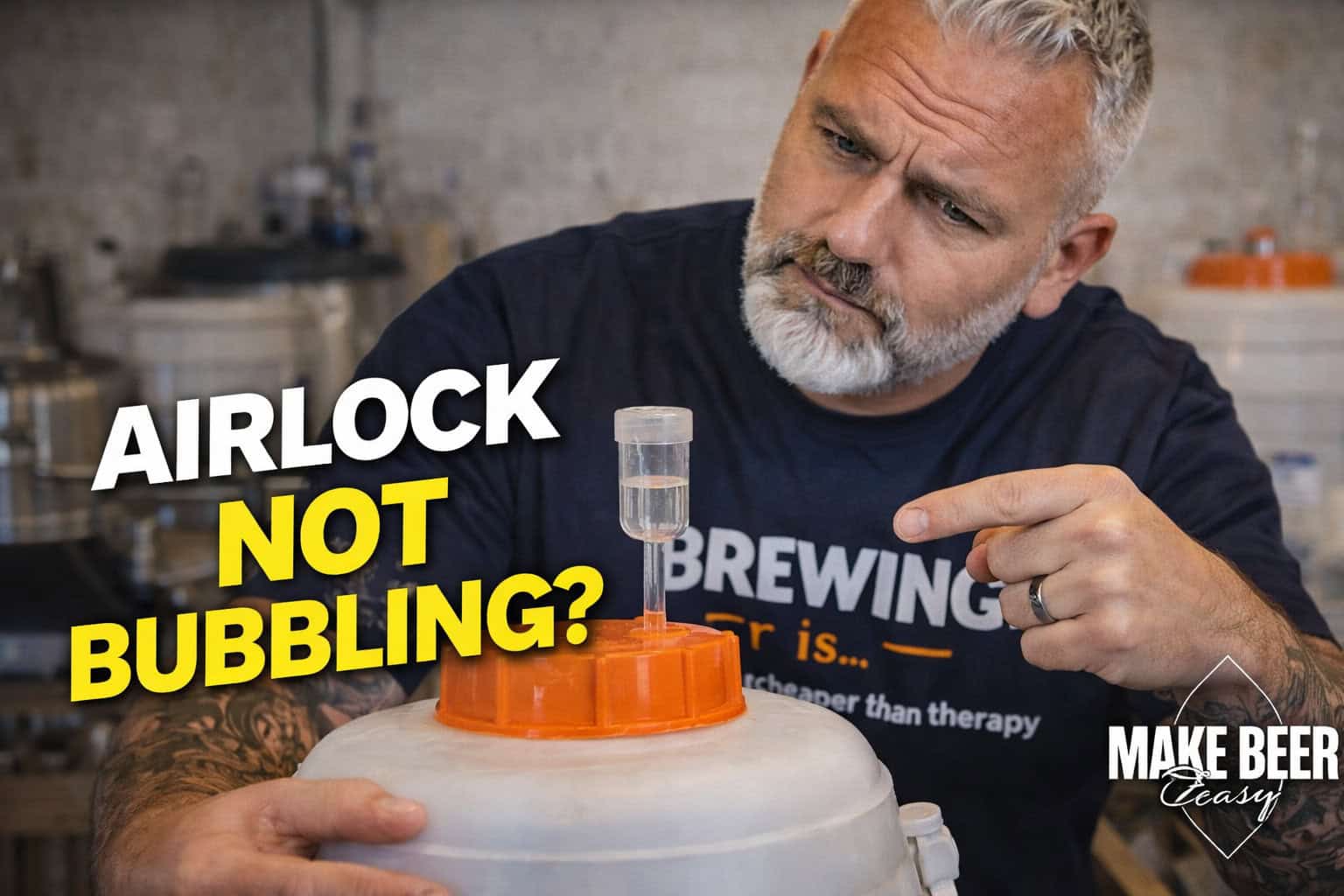
Why your airlock isn’t bubbling is one of the most common questions new homebrewers ask, and if you’ve ever stared at your fermenter wondering whether your beer is ruined, you’re definitely not alone.
I can’t tell you how many times I’ve heard it.
“Robb, my airlock isn’t bubbling. Did I ruin the beer?”
The short answer is almost always no.
One of the biggest mistakes beginner brewers make is assuming the airlock is some kind of fermentation gauge. It isn’t. Airlocks can be helpful, but they are not a reliable way to determine whether fermentation is happening.
Let’s walk through the most common reasons your airlock isn’t bubbling, what it actually means, and when you should or shouldn’t worry.
What an Airlock Actually Does in Homebrewing
Before we jump into the reasons your airlock isn’t bubbling, it helps to understand what the airlock is supposed to do in the first place.
An airlock serves one simple purpose in homebrewing: it allows carbon dioxide (CO₂) to escape from the fermenter while preventing outside air and contaminants from getting in.
When yeast ferments your beer, it produces two main things:
• Alcohol
• Carbon dioxide (CO₂)
That carbon dioxide needs somewhere to go, and the airlock provides an escape path.
As CO₂ pushes through the airlock liquid, you see those familiar bubbles. That bubbling is often the first sign fermentation has started.
But here’s the important thing: just because your airlock isn’t bubbling doesn’t mean fermentation isn’t happening.
In fact, there are several completely normal reasons why an airlock might appear inactive.
Watch This Video First:
Reason #1: Fermentation Hasn’t Started Yet
One of the most common reasons your airlock isn’t bubbling is simply that fermentation hasn’t started yet.
After pitching yeast into your wort, the yeast needs time to wake up and begin reproducing. This phase is called the lag phase, and it can last anywhere from 12 to 36 hours depending on several factors.
Things that influence how quickly fermentation starts include:
• Yeast health
• Wort temperature
• Oxygen levels
• Yeast strain
• Pitch rate
If you used dry yeast, for example, it may take a little time for the yeast to rehydrate and get going.
If your fermentation temperature is on the cooler side, things may also start more slowly.
So if your airlock isn’t bubbling yet and it’s only been a few hours since you pitched the yeast, the best thing you can do is relax and give it time.
Reason #2: Fermentation Already Finished
Another extremely common reason your airlock isn’t bubbling is that fermentation is mostly complete.
New brewers often expect the airlock to bubble continuously for days or weeks, but that’s not how fermentation actually works.
Most of the heavy fermentation activity happens during the first 24 to 48 hours after yeast is pitched. During this period, yeast is consuming sugars rapidly and producing large amounts of CO₂.
After that initial burst of activity, fermentation slows down dramatically.
Your beer may still be finishing fermentation and cleaning up byproducts, but the CO₂ production is much lower, which means the airlock might not bubble anymore.
This is perfectly normal.
In fact, it’s one reason why many experienced brewers follow the simple rule:
Leave your beer in the fermenter for at least two weeks.
Patience almost always leads to better beer.
Reason #3: Your Fermenter Isn’t Perfectly Sealed
Here’s one that surprises a lot of people.
Your airlock might not be bubbling simply because the fermenter isn’t perfectly airtight.
Carbon dioxide always takes the path of least resistance.
If your fermenter lid isn’t sealed tightly, CO₂ may escape around:
• the bucket lid
• the gasket
• the airlock grommet
• loose seals
In those cases, fermentation may actually be happening just fine, but the gas is escaping somewhere other than the airlock.
This happens quite often with plastic bucket fermenters, where the lid doesn’t always seal perfectly.
Again, this usually isn’t a problem for your beer. It just means you can’t rely on the airlock as your fermentation indicator.
Reason #4: Fermentation Temperature Is Too Cold
Temperature plays a huge role in yeast activity.
If your fermentation temperature is too low, yeast becomes sluggish and produces carbon dioxide much more slowly. When that happens, your airlock may appear inactive even though fermentation is still taking place.
Most ale yeast strains perform best between 64°F and 68°F (18–20°C).
If your fermenter is sitting in a cold basement or garage, fermentation may take longer to start and progress more slowly.
In these cases, warming the fermentation environment slightly can help encourage yeast activity.
Just be careful not to overdo it. High fermentation temperatures can create off-flavors in your beer.
Reason #5: The Airlock Isn’t Set Up Properly
Sometimes the issue has nothing to do with fermentation at all.
It could simply be that the airlock itself isn’t functioning properly.
Common airlock issues include:
• Not enough liquid inside the airlock
• The airlock not pushed firmly into the grommet
• The liquid inside the airlock evaporating over time
If the airlock isn’t sealed properly, carbon dioxide can escape without creating bubbles.
Always make sure the airlock is filled to the proper level and seated securely.
Reason #6: Different Yeast Strains Behave Differently
Not all yeast strains ferment the same way.
Some yeast strains produce vigorous fermentation with lots of visible activity. Others ferment more calmly and quietly.
That means two identical batches brewed with different yeast strains could show completely different airlock behavior.
Some yeast strains produce thick krausen and strong bubbling, while others ferment more subtly.
The key takeaway is that airlock activity varies widely depending on yeast strain.
The Most Important Thing to Remember
If you take one thing away from this article, it should be this:
Airlock bubbles are not a reliable way to measure fermentation.
The only accurate way to determine whether fermentation is happening or finished is by using a hydrometer or refractometer to measure gravity.
Gravity readings tell you how much sugar remains in the beer and whether fermentation has completed.
Many experienced brewers barely look at their airlock at all.
They rely on gravity readings instead.
When Should You Actually Worry?
Most of the time, an airlock that isn’t bubbling is nothing to worry about.
However, there are a few situations where you may want to investigate further.
You may have a problem if:
• There is no fermentation activity after 48 hours
• Your gravity reading hasn’t changed at all
• There are signs of contamination
• The yeast you pitched was very old or improperly stored
In those cases, you may need to consider repitching yeast.
But in the vast majority of cases, everything is working exactly as it should.
Final Thoughts
Seeing an airlock stop bubbling can make any new brewer nervous.
But most of the time, it simply means your beer is progressing normally through fermentation.
Brewing great beer requires patience, and fermentation is a process that doesn’t always produce dramatic visual signs.
So if your airlock isn’t bubbling, don’t panic.
Relax, give the yeast time to do its job, and remember that the best tool for checking fermentation isn’t the airlock.
It’s your hydrometer.
And if you keep brewing and learning, your beer will only get better from here.
If you’re new to brewing and want to learn how to make better beer at home, keep following Make Beer Easy. I’ll continue sharing simple tips and techniques to help you brew great beer without overcomplicating the process.