
Let’s be honest…
If someone tells you they’re making wine with grocery store grape juice and bread yeast, your first thought probably isn’t:
“Wow, that sounds delicious.”
It’s usually something closer to:
“That sounds like a terrible decision.”
And naturally, that made me want to try it.
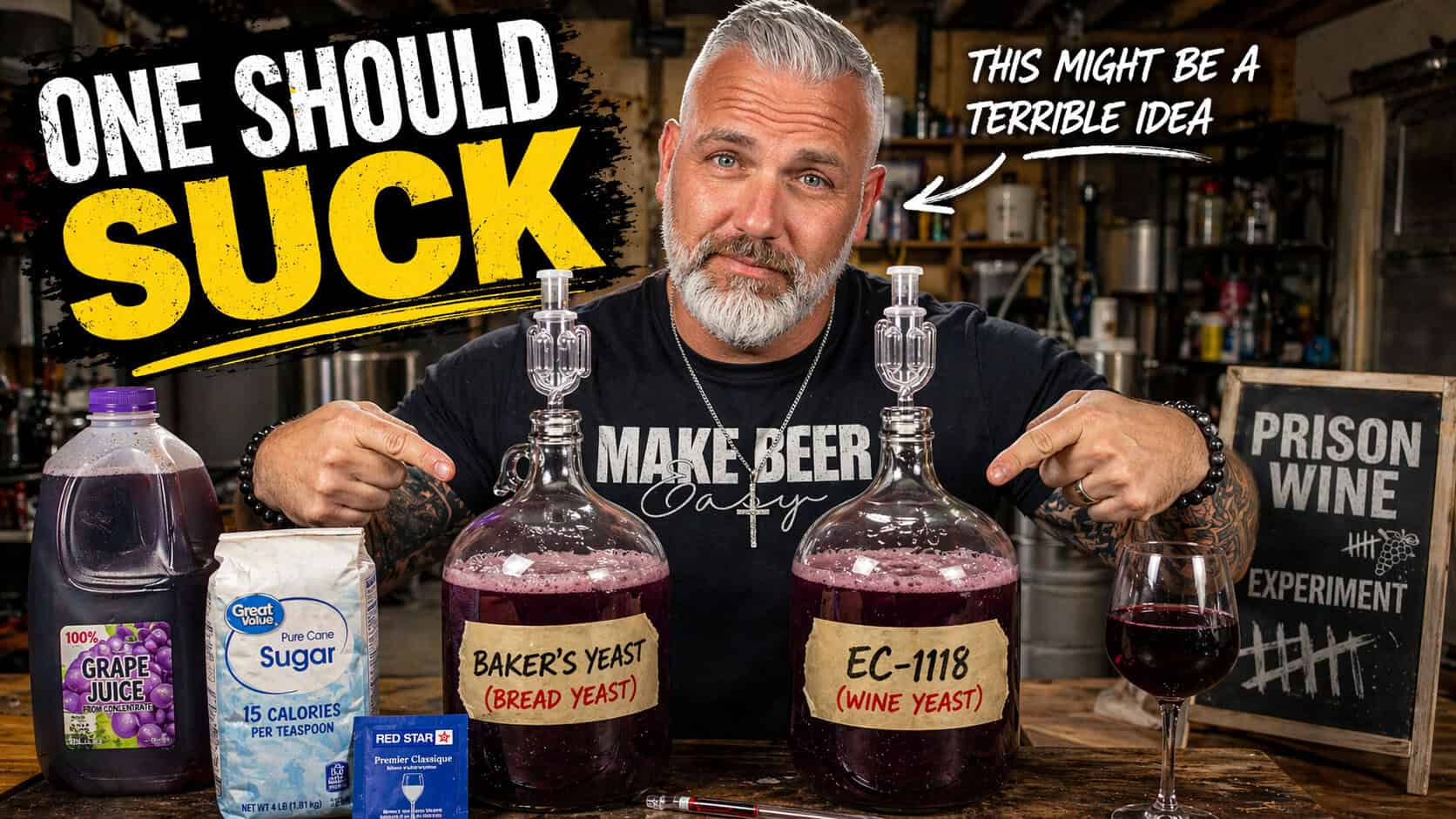
So in this experiment, I made two prison wines using the exact same grape juice, sugar, and setup—but with one major difference:
Batch One:
Bread yeast (baker’s yeast)
Batch Two:
EC-1118 champagne yeast
Same juice.
Same sugar.
Same yeast nutrient.
Same one-gallon fermenters.
Only the yeast changed.
The goal?
To find out if baker’s yeast can actually make drinkable prison wine… or if proper wine yeast absolutely destroys it.
And honestly?
This is one of the most fun beginner fermentation experiments you can do.
This isn’t vineyard wine.
This is inmate merlot.
And we’re about to find out if it belongs in a glass… or an evidence locker.
Watch Full Brewing Video
What Is “Prison Wine”?
“Prison wine” or “prison hooch” is basically homemade alcohol made from whatever fermentable sugar source you can get your hands on.
Most commonly:
- fruit juice
- sugar
- bread yeast
That’s it.
It’s simple.
It’s cheap.
And depending on how reckless you are, it can be surprisingly drinkable.
This is basically country wine with a much worse reputation.
🍺 New to Homebrewing? 🍺
Don’t make the beginner mistakes that ruin batches.
I put together a free Beginner Brewing Bootcamp that walks you through the biggest mistakes new brewers make and exactly how to avoid them.
Get it free here: Beginner Brewing Bootcamp
The Juice Matters More Than People Think
The biggest mistake people make is grabbing the wrong juice.
You want:
100% juice
Not “juice cocktail”
Not “light juice”
Not anything loaded with preservatives.
Specifically, avoid:
- potassium sorbate
- sodium benzoate
Those can slow or completely stop fermentation.
Ascorbic acid (Vitamin C) is totally fine.
That’s common and not a problem.
For this batch, I used a grape + cranberry juice blend that also had apple juice and white grape juice in it.
Was it premium vineyard quality?
Absolutely not.
Was it perfect for prison wine?
Absolutely yes.
If you’ve ever wondered why fermentation seems dead, here’s a great guide on why your airlock stopped bubbling.
The Recipe
For each one-gallon batch:
Ingredients
- 2 jugs grape + cranberry juice
- 3/4 cup white table sugar
- 1 teaspoon yeast nutrient
- 1 full packet baker’s yeast (Batch One)
- 1 full packet EC-1118 champagne yeast (Batch Two)
That’s it.
Simple.
Cheap.
Questionable.
Why I Added Yeast Nutrient
Juice alone can ferment, but it often creates stressed yeast and rough flavors.
Especially with baker’s yeast.
Yeast nutrient helps:
- stronger fermentation
- cleaner flavor
- healthier yeast
- less chance of stalled fermentation
Basically, it gives your prison hooch a fighting chance.
If you’ve ever dealt with fermentation slowing down too early, check out my full guide on how to fix a stuck fermentation.
The Hydrometer Never Lies
Before pitching yeast, I checked the Original Gravity.
This matters.
Because:
Airlocks lie.
Hydrometers tell the truth.
Both batches came in around:
OG: 1.065
That puts potential alcohol roughly around:
8–9% ABV
Depending on final gravity.
Not exactly “light and refreshing.”
More like:
“call your friends and make bad decisions.”
If you’re new to using one, here’s my guide on how to use a hydrometer for homebrewing.
What I Expect to Happen
Baker’s Yeast Batch
Likely:
- sweeter
- rougher
- more bready
- possibly funkier
- lower final ABV
EC-1118 Batch
Likely:
- drier
- cleaner
- stronger
- smoother
- more wine-like
At least… that’s the theory.
Sometimes the ugly cheap option surprises you.
That’s why we test.
🍺 Want Better Beer Recipes? 🍺
One of the fastest ways to improve your brewing is starting with proven recipes.
I put together my Top 5 Best-Selling Brew Pub Recipes—the recipes customers kept coming back for again and again.
Grab them free here: Top 5 Best-Selling Brew Pub Recipes.
The Real Question
If baker’s yeast tastes just as good…
then a lot of people are wasting money.
If EC-1118 crushes it…
then we’ve got proof yeast choice really matters.
Either way, somebody wins.
Probably not my liver.
What Happens Next?
Now we wait.
Fermentation should take around 10–14 days.
Then comes the real test:
Bread Yeast vs Wine Yeast Taste Test
That’s where we find out if we created drinkable wine… or liquid regret.
And honestly?
That’s the video I’m most excited for.
If you’re also experimenting with easy beginner fermentation projects, you might like this guide on the best beginner beers to brew first.
🍺 Want Better Homebrew Every Time? 🍺
If you’re serious about making better beer, avoiding beginner mistakes, and brewing recipes that actually turn out great, I’ve got two free resources for you.
Beginner Brewing Bootcamp
Learn the biggest mistakes beginner brewers make—and exactly how to avoid them before they ruin your batch.
Get it free here: Beginner Brewing Bootcamp
Top 5 Best-Selling Brew Pub Recipes
Want recipes customers kept coming back for again and again?
Grab my Top 5 Best-Selling Brew Pub Recipes here.
Cheers, Big Robb is out!
Make Beer Easy
Simple brewing. Better beer. Made easy.