
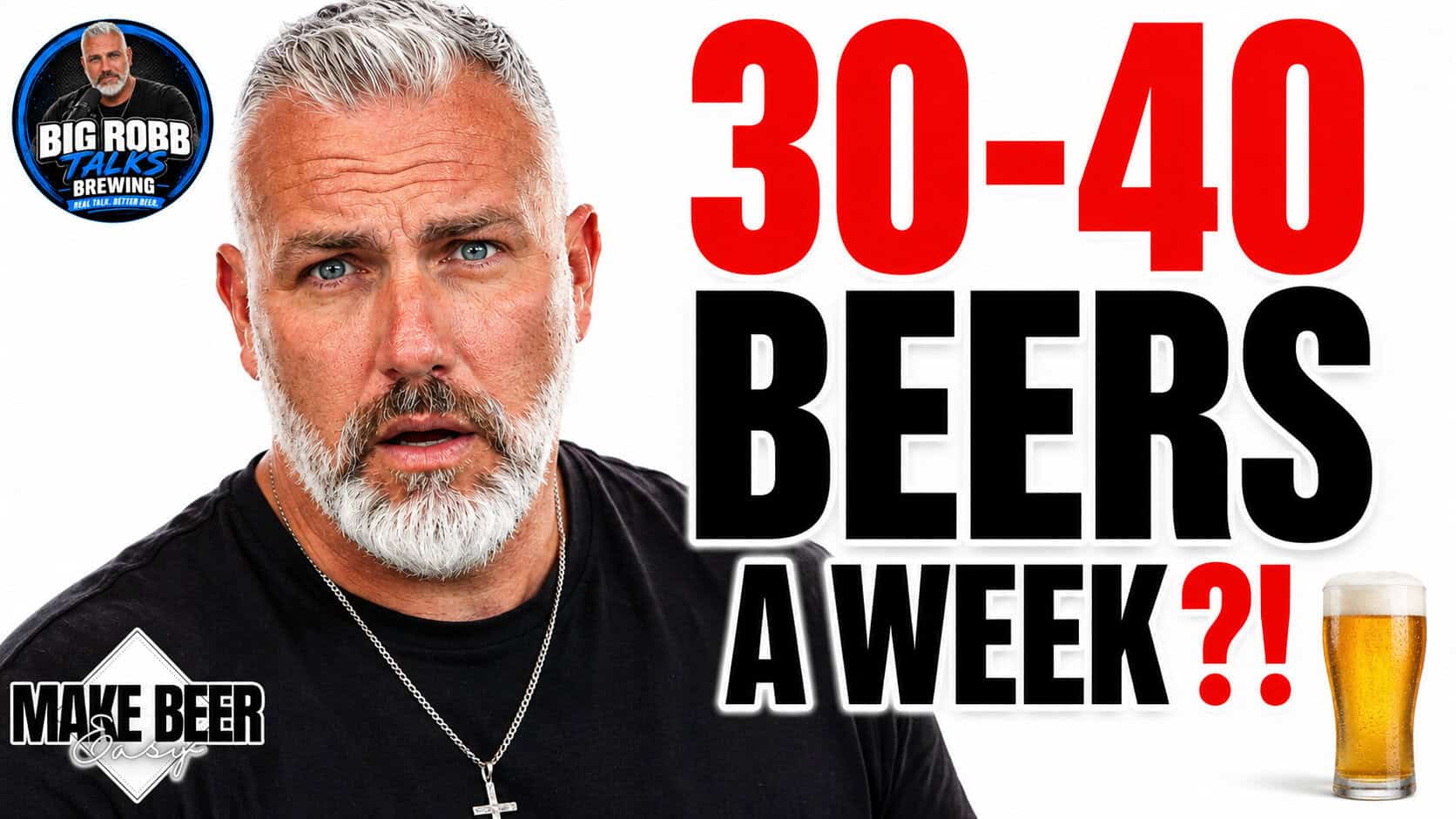
My doctor once asked me a pretty simple question:
“How many beers are you drinking in a week?”
I told him:
“Probably 30 to 40.”
The man damn near fell out of his chair.
And here’s the kicker.
I wasn’t talking about little 12-ounce beers.
During my brewpub days, I was drinking 20-ounce pints.
Now, before anybody starts warming up their keyboard, this isn’t going to be one of those articles where Big Robb suddenly tells everybody beer is evil and we should all switch to sparkling water.
Hell no.
I love beer.
I love making beer.
I love drinking beer.
I love sitting around having a few pints with friends.
I love the social side of the whole damn thing.
Make Beer Easy probably wouldn’t exist if I didn’t.
But there is an elephant in the homebrewing room that I think is worth talking about:
When you make your own beer, it becomes incredibly easy to have a whole lot of beer around all the damn time.
And for some of us, that can make it pretty easy to drink more of it.
Homebrewing didn’t force beer down my throat.
I was the guy drinking it.
But I’d be lying if I said having five gallons sitting on tap ten feet away didn’t make drinking the stuff incredibly convenient.
So let’s talk about it.
Not as a lecture.
Not as medical advice.
Just one homebrewer talking to other homebrewers about something I suspect more of us have thought about than we normally admit.
Does Homebrewing Actually Make You Drink More?
I don’t think it’s fair to say:
“Homebrewing makes people drink too much.”
Plenty of people brew beer and have absolutely no problem controlling how much they drink.
But homebrewing can absolutely change your environment around alcohol.
Before I brewed beer, getting beer meant going somewhere and buying beer.
Once I started brewing?
Beer was already sitting in my house.
Then I started kegging.
Now I didn’t even need to open a bottle.
Walk over.
Grab glass.
Pull tap.
Beer.
That’s a pretty damn efficient delivery system, boys. 😂
And whether you’re brewing from kits, doing partial mash, BIAB or running a full all-grain system, the end result is the same:
You eventually have quite a bit of beer sitting around.
If you’re brand new to the hobby itself, start with my Complete Guide to Homebrewing.
But once you start brewing regularly, I think it’s worth asking yourself one question:
Has having all this beer around changed how much I drink?
Maybe the answer is no.
Great.
For me?
At times, the answer was definitely yes.
The Homebrew Keg Can Be Deceptive
I’ve done this more times than I’d probably like to admit.
I’d keg a beer.
Pull a pint.
Have another one later.
Maybe have a few the next night.
Then suddenly I’m looking at that keg going:
“What the hell happened to that thing?”
Five gallons sounds like a lot of beer.
Because it is.
But unlike a case of bottles, you can’t see how much is disappearing.
If you buy 24 bottles and there are four sitting in the fridge, it’s pretty obvious what happened.
With a keg?
There’s no little fuel gauge saying:
WARNING: BIG ROBB HAS CONSUMED 73% OF THIS KEG.
You’re just pulling pints.
Make Beer Easy has a full guide on how many beers are actually in a keg if you’ve never stopped to work it out.
You might be surprised.
Your “One Beer” Might Not Be One Drink
This is another thing homebrewers should understand.
We tend to talk in beers.
“I had three beers.”
Okay.
What size?
What ABV?
Those two things make a huge difference.
Using the U.S. standard-drink definition, roughly 12 ounces of 5% beer equals one standard drink. A 12-ounce beer at 10% contains roughly twice as much alcohol. (NIAAA)
That means one of my old 20-ounce pints at 5% ABV is roughly 1.7 U.S. standard drinks.
And homebrew isn’t always 5%.
We make:
- 7% IPAs
- 8% Belgian beers
- 10% imperial stouts
- barleywines
- double IPAs
- all kinds of beautiful high-octane shit
So “three beers” can mean very different things depending on what’s in your glass.
That’s another reason I think homebrewers should know the strength of what they’re drinking.
You’ve already got a hydrometer.
You’ve already measured your OG and FG.
Might as well know what you made.
Here’s my guide to Calculating Alcohol By Volume if you need a refresher.
🛠️ Brew Smaller Without Giving Up Homebrewing
One of the easiest changes I’ve made is brewing smaller batches.
You still get everything that’s fun about homebrewing.
You get to:
- build a recipe
- mash grain
- play with hops
- ferment beer
- test new ideas
- improve your process
- taste the finished product
You just don’t automatically end up with five gallons every damn time.
A one-gallon or two-gallon batch can be a fantastic option if you love brewing but don’t need another forty or fifty beers sitting around your house.
And small-batch brewing is also excellent for experimenting because if the recipe doesn’t turn out exactly how you hoped, you’ve only got a small amount of it.
If you’re thinking about building a smaller setup, check out my Beer Brewing Equipment Hub.
I’ve got recommendations there specifically for 1-gallon small-batch brewing, beginner setups, fermenters, kettles, scales and everything else you actually need. (Details Here!)
Don’t buy equipment just because some guy on YouTube has a stainless-steel brewery worth more than your damn car.
Buy what fits your brewing.
Some equipment recommendations on Make Beer Easy use affiliate links, which means I may earn a commission if you buy through them, at no additional cost to you.
Brew Day Can Become Drinking Day
Years ago my buddy Mad Dawg and I used to brew constantly.
Sometimes on my system.
Sometimes on his.
Sometimes both.
We’d brew every weekend, and sometimes twice on the same weekend.
And naturally, what were two guys sitting around making beer going to do?
Drink beer.
Of course.
There’s nothing inherently wrong with enjoying a pint on brew day.
I’m sure as hell not going to pretend I’ve never done it.
But brew day can be five or six hours long.
And it’s very easy to turn every brewing milestone into a drinking milestone.
Mash in?
Beer.
Start the boil?
Beer.
Hop addition?
Apparently that deserves another beer.
Whirlpool?
Beer.
Transfer to the fermenter?
Victory pint!
Suddenly you didn’t have a beer while brewing.
You had six.
And because brewing and drinking become connected in your head, it can turn into part of the routine without you really thinking about it.
When Your Whole Life Revolves Around Beer
Things really ramped up for me when I owned the brewpub.
At that point beer wasn’t simply my hobby anymore.
It was my business.
I worked around beer.
My customers were drinking beer.
I was tasting beer.
My social life involved beer.
I was thinking about beer all damn day.
And obviously, I enjoyed drinking it.
That’s where that 30–40 pints per week conversation with my doctor came from.
Again, I don’t blame the brewpub.
Nobody from the brewery was pinning me down and pouring beer into my mouth.
But environment matters.
When something you really enjoy is constantly available, consuming more of it becomes pretty damn easy.
The Slippery Seventh Beer
This might be my favorite description of my own drinking pattern.
I’ve gotten much better at going out and having a couple of pints.
I can have two.
I can have three and have a great night.
But somewhere farther down that road sits what I call:
The Slippery Seventh Beer
That’s when responsible Big Robb says:
“Okay, boys. That’s probably enough.”
And the other Big Robb goes:
“WE’RE JUST GETTING STARTED, BABY!”
😂
Everybody’s different.
Your number might not be seven.
You might not have a number at all.
My point is simply that I’ve learned something about myself.
There is a point where my decision-making gets considerably worse.
That’s useful information.
Because if I know where the road tends to go, I can make the decision before I get there rather than negotiating with myself once I’m already six beers deep.
Set the Boundary Before Beer Number One
This has been one of the biggest changes for me.
It is much easier to decide:
“I’m going out for three pints.”
before I’ve had anything than it is to make that same decision later in the night.
Once you’re already feeling good and having fun, suddenly every argument for “just one more” sounds like brilliant logic.
So I’ve started trying to make that decision earlier.
How many?
When?
What days?
When am I done?
I’m not saying I execute that perfectly every damn time.
I’m human.
But being conscious of it is a hell of a lot different than just letting the night decide.
Brewing Smaller Batches Changed Things for Me
I used to brew constantly.
Part of that was because I love brewing.
And now part of it is obviously Make Beer Easy.
I need beer to make brewing content.
But eventually I looked around and thought:
I don’t need this much damn beer in my house.
That’s one of the reasons you’ve seen me doing more smaller batches.
I still get to brew.
I still get to make videos.
I still get to experiment.
I still get to taste the beer.
I simply don’t have five new gallons appearing every week.
If your favorite part of homebrewing is actually making beer, smaller batches let you keep doing what you love without creating an endless beer supply.
Give Some of the Damn Beer Away
This one has worked great for me.
Friends and family make excellent excess-homebrew disposal systems. 😂
I’ve basically got a growler exchange going.
I’ll tell people:
“I’ve got beer on tap. Bring over a couple empty growlers.”
They arrive empty.
They leave full.
Everybody wins.
I get to brew.
They get homebrew.
And I don’t have four full kegs staring at me every time I walk through the house.
Obviously follow whatever laws apply where you live.
I’m talking about sharing some beer with family and friends.
I’m not opening Big Robb’s Underground Bootleg Brewery and selling growlers out of the garage.
I don’t need the law dogs knocking on my damn door.
You Don’t Have to Drink Every Beer You Brew
This sounds obvious.
But there’s something about making your own beer.
You want to taste it.
Then you want to see how it changed after another week.
Then you want to check the carbonation.
Then you want to compare it with the other beer you made.
Then you want to see whether that extra hop addition actually mattered.
That’s part of brewing.
Nothing wrong with it.
But there’s a difference between:
tasting your beer
and
feeling responsible for personally drinking every gallon you produce.
You don’t have to.
Share it.
Give some away.
Take it to a get-together.
Split batches with another brewer.
Get other people to taste your beer.
In fact, getting other people’s opinions can make you a better brewer anyway.
🍺 Bottling vs Kegging — Pick the Setup That Works for You
I love kegging.
I’m not giving up my kegs.
But bottles have one interesting advantage when it comes to keeping track of your beer:
They’re visible units.
Drink three bottles?
There are three empties.
Pretty obvious.
With a keg, one pour might be 10 ounces.
The next one 16.
Big Robb’s pint might be 20.
And after a few, who the hell is measuring?
Neither bottling nor kegging automatically determines how much somebody drinks.
But if you’re deciding how you want to package your beer, it’s worth thinking about what works best for you.
Make Beer Easy has a complete Kegging & Bottling Equipment Hub with the bottling and kegging equipment I recommend — bottles, bottling gear, Cornelius kegs, CO₂ systems, regulators, beer lines, temperature control and home draft setups.
You can also learn the actual processes in my Brewing Guides:
and
Use whatever system makes brewing easier for you.
Take Some Time Away From Beer
Another thing I’ve done over the years is take a month away from alcohol.
I’ve done Dry January.
Sometimes I’ll do another month during the year.
When I first told my father I was doing Dry January, he asked:
“Why the hell are you doing it in January?”
He knew a guy who did the same thing every year.
Except that guy picked February.
Why?
28 days instead of 31.
Fair point, Dad.
😂
For me, taking time away isn’t punishment.
I’m not sitting around thinking:
BEER IS EVIL. I MUST CLEANSE MY SOUL.
Give me a break.
It’s simply a reset.
It reminds me that beer doesn’t need to be attached to every weekend, every social event and every good time.
And when I decide to have beer again?
I still enjoy the hell out of it.
Make Lower-Alcohol Beer — Or Even Non-Alcoholic Beer
Here’s another idea that I think homebrewers sometimes overlook.
You control the recipe.
That’s one of the coolest things about this hobby.
Nothing says every beer you brew has to be a 7.8% hop bomb.
You can make:
- session IPAs
- ordinary bitters
- milds
- lower-gravity lagers
- table beers
- lower-ABV pale ales
- non-alcoholic beer
You still get to brew.
You still get to play with malt and hops.
You still get to ferment something.
You still get the process we love.
But not every pint has to carry a pile of alcohol with it.
I’ve got a complete Make Beer Easy guide on How to Brew Non-Alcoholic Beer if that’s something you’d like to experiment with.
Even if you go completely alcohol-free, brewing a few lower-ABV beers can give you more options.
Exercise, Water and Supplements Don’t Cancel Out Alcohol
I want to clarify something I talked about in the video.
I exercise.
I lift weights.
I walk.
I’ve started rucking again.
I try to eat fairly well.
I drink a pile of water.
And yes, I take supplements.
Those things are part of how I personally try to take care of my overall health.
But I don’t want somebody reading this and coming away thinking:
“Big Robb says you can drink 30 beers as long as you work out, drink water and take milk thistle.”
No.
That isn’t what I’m saying.
There isn’t some health-accounting system where you drink ten beers Saturday and then erase them with squats Monday morning.
Current public-health guidance is pretty simple on this part: drinking less alcohol carries less health risk than drinking more alcohol. (CDC)
So yes.
Exercise.
Eat well.
Hydrate.
Look after yourself.
But don’t use any of those things as an excuse to convince yourself alcohol suddenly doesn’t count.
The most direct way to reduce alcohol-related risk is simply:
Drink less alcohol.
High-ABV Homebrew Can Sneak Up on You
This deserves mentioning again because homebrewers make some powerful damn beer.
A commercial light lager might be 4%.
Your homebrewed double IPA might be 9%.
Those are not the same thing.
NIAAA notes that a 12-ounce 5% beer is about one U.S. standard drink, while the same amount of 10% beer contains about two. (NIAAA)
That’s another reason knowing your ABV matters.
If you’re pulling 20-ounce pints of strong homebrew, “I only had three beers” may not describe very well how much alcohol you actually consumed.
We’re brewers.
We measure this shit.
Use the information.
Enjoying Beer Isn’t the Same as Drinking as Much as Possible
This is something I’ve thought about more as I’ve gotten older.
When I was younger, sometimes the definition of a good beer night was:
How many can we put away?
I’m not going to pretend those nights weren’t fun.
Sometimes they absolutely were.
But these days I can sit somewhere, have two or three really good pints, shoot the shit with somebody and have a hell of a time.
Eventually there’s a point where I’m no longer appreciating:
- the hop aroma
- the malt
- the yeast character
- carbonation
- mouthfeel
- whether the beer is actually any damn good
I’m drinking beer because I’m drinking beer.
Those are two different things.
And I’m getting better at recognizing the difference.
When This Becomes More Than a Homebrewing Problem
There’s an important distinction here.
This article is mostly aimed at somebody thinking:
“You know what? Having all this beer around might be making it easier for me to drink more than I really want.”
That’s different from somebody who is struggling to control their drinking.
Signs that deserve to be taken seriously can include regularly drinking more or longer than intended, repeatedly trying to cut down and being unable to, alcohol interfering with responsibilities or relationships, craving alcohol, or continuing despite problems caused by drinking. Those are among the symptoms healthcare professionals assess when evaluating alcohol use disorder. (NIAAA)
That’s where my advice becomes:
Don’t get your medical advice from Big Robb walking around with a backpack talking into a camera.
Talk to somebody qualified.
And there’s another important point.
If somebody has been drinking heavily for a prolonged period, suddenly stopping can cause dangerous and potentially life-threatening withdrawal. Medical guidance may be needed. (NIAAA)
That’s no longer a homebrewing strategy problem.
That’s healthcare territory.
I’m Not Anti-Beer
I want to make this perfectly clear.
Make Beer Easy is not becoming:
MAKE WATER EASY
😂
I’m still brewing.
I’m still drinking beer.
I’m still doing taste tests.
I’m still going to get excited when I brew something and take that first sip and go:
“Holy shit, that’s good.”
I love this hobby.
The goal isn’t to remove beer from my life.
The goal for me is making sure I decide how beer fits into my life rather than beer making that decision for me.
That’s a pretty big difference.
What I’ve Personally Changed
Here’s what has helped me find a better balance:
- I don’t brew as often. I don’t need another five gallons every damn week.
- I brew smaller batches. I still get to make beer without creating mountains of it.
- I give more beer away. Friends and family are very cooperative with this particular strategy.
- I try to decide my limit beforehand. Decisions made before pint number one tend to be better than decisions made around the slippery seventh.
- I take periods completely away from alcohol. A month once or twice a year has worked well for me.
- I pay attention to ABV and serving size. One homebrew isn’t always equivalent to one standard drink.
- I work on my overall health. Exercise, food and hydration matter, while understanding none of them magically cancel alcohol.
- I ask myself why I’m having the beer. Do I actually want this beer, or is it simply sitting five feet away?
None of that is a prescription for anybody else.
It’s what I’ve found useful for me.
There’s No One Answer for Every Homebrewer
Somebody reading this might brew every Saturday and drink two beers a month.
Someone else might brew once every six months and drink every night.
Some people brew primarily because they love recipe development.
Some love building equipment.
Some love competitions.
Some love the science.
Some got into homebrewing because:
“Holy shit, I can make five gallons of beer?”
😂
We’re adults.
We make our own decisions.
I’m not interested in judging anybody else’s choices.
I am interested in being honest about mine.
I love beer.
And because I love beer, having unlimited quantities sitting around me can sometimes be a little too damn convenient.
Recognizing that doesn’t mean I need to quit the hobby.
It means I can change how I do the hobby.
Continue Learning
If this has you thinking about changing how you brew rather than giving up brewing, these Make Beer Easy Brewing Guides can help.
Start with my Complete Guide to Homebrewing if you’re still learning the overall process.
Learn how to accurately determine the strength of your beer with .
If you’re curious how much beer that keg actually represents, check out .
And if you like the idea of continuing to brew while making something with little or no alcohol, read .
All of those guides are part of the Make Beer Easy Brewing Guides library. (Make Beer Easy Guides)
You don’t have to stop brewing simply because you’ve decided you don’t need as much finished beer around.
Change the system. Keep the hobby.
🛠️ Equipment Used & Recommended
You don’t need any special equipment because of what we’re talking about in this article.
But if you’re deliberately changing your setup to brew smaller amounts of beer, a few things become useful:
- smaller kettle or brewing system
- 1-gallon or small-batch fermenter
- digital scale
- hydrometer
- thermometer
- small batch bottling equipment
- swing-top bottles
- growlers for sharing beer
- kegging equipment if that’s how you package
- proper cleaning and sanitation equipment
The nice thing is you don’t need to rebuild your entire brewery.
You can keep your existing setup and simply brew smaller.
Or you can put together a dedicated little small-batch system.
I’ve got my actual brewing recommendations organized in the , including a section specifically for 1-gallon brewing equipment. (Make Beer Easy Recommended Equipment)
And if you’re specifically deciding between bottling and kegging, use my Make Beer Easy Kegging & Bottling Equipment Recommendation
That’s where you’ll find the equipment I recommend.
Educate yourself first. Figure out what actually solves your problem. Then buy the gear.
Not the other damn way around.
🚀 New to Homebrewing? Start Here
If you’re brand new to making beer and you’re looking at all of this going:
“Big Robb, I haven’t even brewed the first damn batch yet.”
I’ve got you covered.
My Beginner Brewing Bootcamp walks you through the fundamentals of making good beer without turning homebrewing into a chemistry degree.
You’ll learn the brewing process, the biggest beginner mistakes, fermentation, sanitation and the equipment you actually need.
Simple brewing.
Better beer.
Made easy.
📬 Want My Best Brew Pub Recipes?
If you’re already brewing and want some proven beer recipes to work with, I’ll send you my Top 5 Best-Selling Beer Recipes from my brewpub as my gift to you.
These are beers actual customers came back and ordered again and again, along with bonus recipes and brewing tips.
Brew them.
Change them.
Make them your own.
That’s half the fun.
Frequently Asked Questions
Does homebrewing make you drink more?
Not necessarily.
Millions of people can brew beer without changing how much they drink.
But homebrewing does make beer extremely accessible. If you’ve constantly got bottles or kegs of beer sitting at home, some people may find themselves drinking more simply because the beer is always there.
That’s something I personally noticed.
Why can kegging make it harder to keep track of beer?
Because you’re pouring from one large container instead of opening individual bottles.
You may also pour different amounts every time.
A 10-ounce glass, 16-ounce pint and 20-ounce pint aren’t the same thing.
Knowing roughly what you’re pouring and the ABV of your beer gives you a much better picture.
Is one pint of beer one standard drink?
Not necessarily.
Using the U.S. definition, approximately 12 ounces of 5% beer equals one standard drink. (NIAAA)
A 20-ounce pint of the same beer contains considerably more alcohol.
And if your homebrew is 8%, 9% or 10%, the difference becomes even larger.
How can I keep homebrewing without having so much beer around?
You have plenty of options.
Brew smaller batches.
Brew less frequently.
Give beer away where legal.
Split batches with another homebrewer.
Brew lower-ABV styles.
Try non-alcoholic beer.
You don’t have to produce five gallons every time you want the experience of brewing.
Are one-gallon batches worth brewing?
Absolutely.
They’re fantastic for recipe experiments, beginners, people with limited space and anyone who simply doesn’t want five gallons of every beer they brew.
You still learn exactly the same brewing fundamentals.
Does drinking water offset alcohol?
No.
Water helps with hydration, but it doesn’t erase the effects or health risks of alcohol.
Drinking less alcohol is what reduces alcohol-related health risk. (CDC)
Can exercise offset drinking?
Exercise is fantastic for general health.
It doesn’t provide a free pass on alcohol.
I exercise because I want to be healthier as I get older.
I don’t exercise because I think an hour in the gym magically deletes six pints from Saturday night.
What about supplements for liver health?
I talked in the video about supplements I personally take.
I’m not recommending supplements as protection against alcohol, and I wouldn’t use them as justification to drink more.
Questions about supplements, liver health, medications or alcohol-related health concerns belong with an appropriate healthcare professional.
Can I homebrew non-alcoholic beer?
Yep.
You can make low-alcohol and non-alcoholic beers at home while still enjoying the brewing process.
If that’s something you’re interested in experimenting with, Make Beer Easy has a complete guide to brewing non-alcoholic beer.
When should someone get help with their drinking?
If you’re repeatedly drinking more than you planned, unsuccessfully trying to cut back, alcohol is interfering with responsibilities or relationships, or you’re continuing despite problems caused by drinking, those are worth taking seriously and discussing with a qualified healthcare professional. (NIAAA)
And if you’ve been drinking heavily for a prolonged period, don’t assume suddenly stopping on your own is automatically safe. Severe alcohol withdrawal can be dangerous. (NIAAA)
Conclusion
So…
Does homebrewing make you drink more?
For everybody?
No.
For me?
At certain points in my life, I think having that much beer constantly around absolutely made it easier.
I’ve owned a brewpub.
I’ve brewed professionally.
I’ve brewed at home for years.
I’ve watched kegs disappear ridiculously fast and thought:
“What the hell happened to that keg?”
And I’ve sat across from my doctor and told him I was drinking 30–40 pints a week and watched the poor bastard almost fall out of his chair.
None of that means I’ve suddenly become anti-beer.
Far from it.
I fucking love beer.
I love brewing.
I’m still going to brew.
I’m still going to taste beer.
I’m still going to have pints with friends.
I’ve simply realized that loving homebrewing doesn’t mean I need unlimited quantities of beer sitting around me every damn day.
So I brew smaller batches.
I brew a little less often.
I give more beer away.
I take breaks.
I try to set some boundaries.
And I try to stay on the correct side of that slippery seventh beer.
For me?
That’s the balance.
Keep brewing. Keep enjoying good beer. Just make sure you’re the one making the decisions.
Cheers!
Big Robb
Leave a Comment
Now I want to hear from you guys because that’s really why I made the video in the first place.
Has homebrewing changed how much beer you drink?
Do you brew smaller batches?
Give a bunch away?
Take months off?
Only drink certain days?
Or are you one of those magical bastards who has five full kegs sitting ten feet away and doesn’t even think about them?
Drop a comment below.
No preaching.
No judging anybody else’s choices.
I’m genuinely interested in how other homebrewers deal with the elephant in the homebrewing room.