
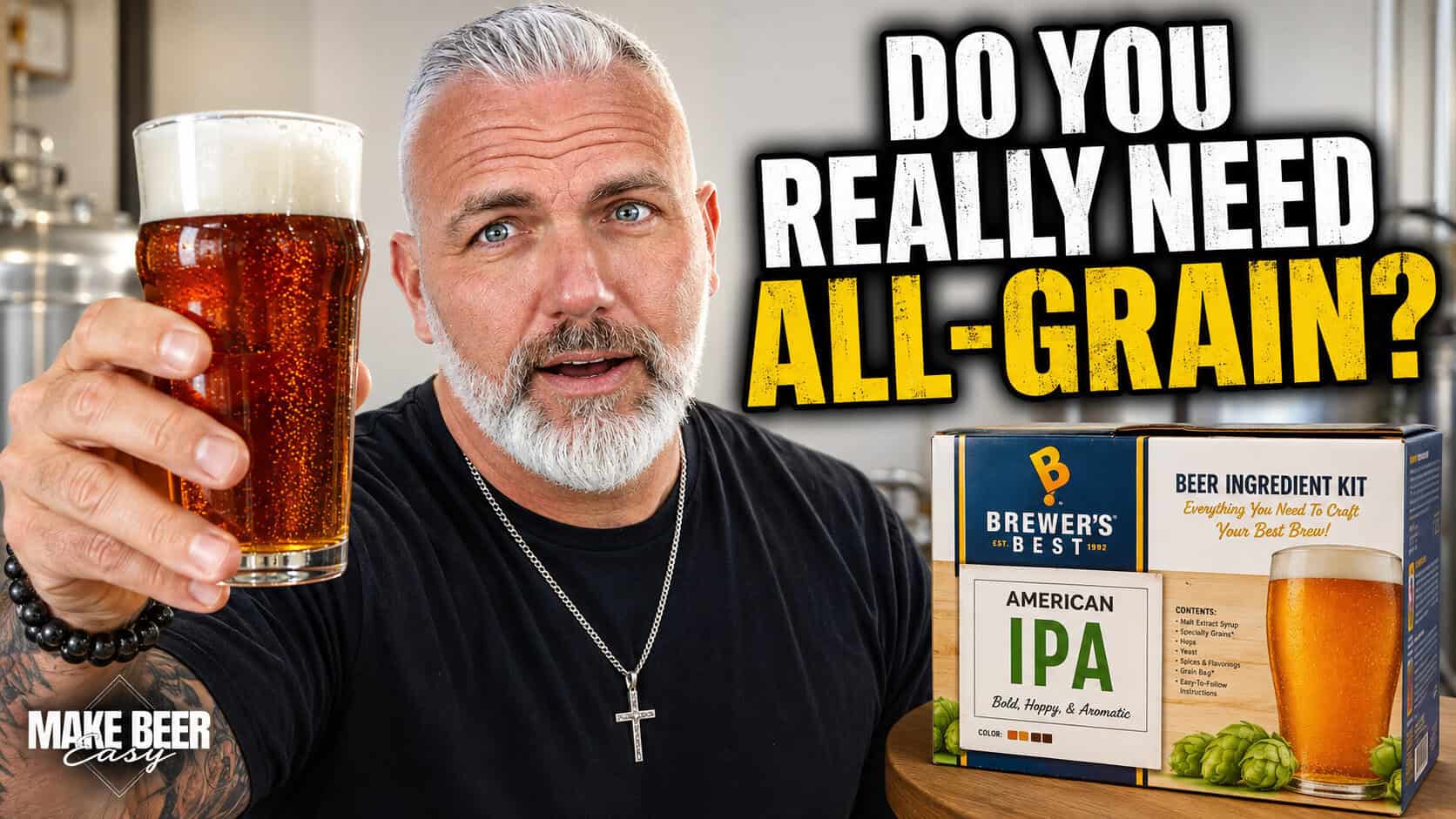
One of the biggest mistakes beginner homebrewers make is thinking they have to jump from a simple beer kit straight into a full-blown all-grain brewing system.
You don’t.
There is a whole middle ground between cracking open a can of malt extract and spending half the day mashing, sparging, boiling and cleaning up after an all-grain brew day.
And that middle ground can make some damn good beer.
I was reminded of that recently when I brewed a Brewer’s Best one-gallon American IPA kit, which I affectionately named the Mud Monster IPA.
When I finally tasted the finished beer, I was impressed.
The carbonation was bang on. The beer was clear. It held a nice head. It tasted good.
In fact, if I handed that beer to somebody without telling them how it was brewed, I seriously doubt they would take a sip and say:
“Ah yes, clearly this was brewed with malt extract.”
That is the point of this article.
You do not have to brew all-grain beer to make good beer.
And if you currently brew simple malt extract kits and want to take another step toward traditional brewing, there are a couple of stages in between that are worth understanding.
We are going to look at:
- pre-hopped beer kits
- extract brewing with specialty grains
- true partial mash brewing
- all-grain brewing
- what changes at each level
- what equipment you actually need
- whether moving up really makes your beer better
And I will also show you where the Mud Monster IPA fits into all of this.
What Is Partial Mash Brewing?
Partial mash brewing is exactly what the name sounds like.
Part of the fermentable sugar in your beer comes from mashing grain, while the rest comes from malt extract.
It sits somewhere between extract brewing and all-grain brewing.
With all-grain brewing, practically all of the fermentable sugars that eventually become alcohol are created by mashing malted grain.
With partial mash brewing, you let some grain do that work while malt extract handles the rest.
That means you can start learning the all-grain process without needing a full all-grain setup.
If you want my complete step-by-step process, check out my guide to partial mash brewing.
But there is another brewing method we need to talk about because people often confuse the two.
Level 1: Pre-Hopped Beer Kits
This is where I still recommend most brand-new homebrewers start.
Think:
- Coopers
- Muntons
- Mr. Beer
- similar pre-hopped malt extract kits
I jokingly call them the can of goo, but there is nothing wrong with brewing this way.
The manufacturer has already done a huge amount of the work for you.
The malt extract contains the fermentable sugars you need, and in many kits the hop bitterness and flavor have already been incorporated.
Your job is basically to:
- Clean and sanitize.
- Dissolve the extract.
- Add water.
- Get the temperature right.
- Pitch the yeast.
- Ferment the beer.
- Bottle or keg it.
- Let it carbonate.
- Drink it.
Simple.
If you are just getting started, my beer kit brewing guide walks through this style of brewing in much more detail.
Why Start With a Beer Kit?
Because it teaches the things that actually ruin most beginner batches.
Things like:
- sanitation
- fermentation temperature
- pitching yeast correctly
- patience
- bottling
- carbonation
- keeping oxygen away from finished beer
Those skills matter whether you are using a $30 beer kit or a $3,000 brewing system.
🛠️What You Actually Need to Start Brewing Better Beer 🛠️
If you are starting from scratch, do not buy every shiny brewing gadget you see.
You need surprisingly little equipment to make good beer.
I keep the equipment I actually recommend on my Beer Brewing Equipment page.
Start simple. You can always add more gear later.
Level 2: Extract Brewing With Specialty Grains (Partial Mash)
This is where things start getting really interesting.
Instead of using a pre-hopped can where most of the recipe decisions have already been made, you usually work with:
- dry malt extract (DME) or liquid malt extract (LME)
- specialty grains
- hops
- yeast
The malt extract still provides most of your fermentable sugar.
If malt extract is new to you, I have a complete beginner explanation here: What Is Malt Extract?.
The specialty grains add things such as:
- color
- roasted flavors
- caramel flavors
- body
- malt character
- mouthfeel
- head retention
And instead of relying on a pre-hopped extract, you normally add the hops yourself.
That means you suddenly have much more control over the finished beer.
You are starting to build a beer instead of simply preparing one.
And that is a pretty cool step.
Where the Brewer’s Best Mud Monster IPA Fits
The Brewer’s Best one-gallon American IPA I brewed fits into this category.
The kit used dried malt extract along with specialty grains and separate hop additions.
I steeped the grains, boiled the wort, added the extract and hops, fermented it, cold crashed it, fined it, bottled it and then let it carbonate for two weeks.
You can see the original brew day here:
Brewing a Brewer’s Best IPA Kit — And I Screwed Up
The finished beer surprised me.
What Turned Out Well
The clarity was excellent.
Now, to be fair, I left this poor bastard cold for a long time.
But that is one of the advantages of cold crashing beer. Yeast and other material suspended in the beer settle out, leaving you with a cleaner-looking finished pint.
The carbonation was also bang on after two weeks in the bottle.
The head formed nicely and, more importantly, actually stuck around.
Flavor-wise, it was a good beer.
Very drinkable.
And that is the important lesson.
Extract-based beer does not automatically taste like inferior beer.
If you use decent ingredients and handle fermentation properly, you can make beer with extract that most people would never identify as extract beer.
What I Would Change About the Brewer’s Best American IPA
There was one thing that surprised me.
For something called an American IPA, this beer was very malt-forward.
I picked up much more malt character than hop character.
It was not bad.
Far from it.
But when I think American IPA, I want the hops standing up and announcing themselves a little more.
This beer did not do that.
I Would Dry Hop It
If I brewed the kit again, the first change I would make would be a dry hop.
Something like:
- Cascade
- Centennial
- perhaps a combination of the two
would be right at home in an American IPA.
Dry hopping adds hop aroma and flavor without adding the same kind of bitterness you get from boiling hops.
If you have never done it before, check out my complete guide on how to dry hop beer.
For a small one-gallon batch, you do not need to go crazy.
A little goes a long way.
I Might Also Dry the Beer Out Slightly
I also mentioned during the taste test that I might “thin it out.”
What I really meant was dry it out a little.
I would want slightly less of that malt-forward character and a somewhat crisper finish.
One way to experiment with that in an extract recipe is to replace a small portion of the malt extract with a highly fermentable simple sugar such as dextrose.
The key word there is replace.
If you simply dump extra dextrose into the existing recipe, you are also raising the original gravity and probably the alcohol level.
Replacing a small portion of the extract lets you adjust the character of the beer without simply making a stronger beer.
Would I completely rebuild this recipe?
No.
It tasted good.
I would make small changes first.
That is another lesson worth remembering:
Do not fix what is not broken.
Change one or two things, brew it again and see what happens.
🌾 Better Ingredients Make Better Beer🌾
Once you move beyond simple pre-hopped kits, ingredient quality starts becoming even more important because you are selecting more of the recipe yourself.
That means thinking about malt extract, grain, hops and yeast separately.
You can see the brewing ingredients I recommend on the Make Beer Easy Homebrew Ingredients page:
Homebrew Ingredients Big Robb Recommends
You do not need exotic ingredients.
Fresh ingredients and a good recipe will beat a complicated ingredient list every damn time.
Level 3: All-Grain Brewing
Eventually some brewers decide they want complete control.
That is where all-grain brewing comes in.
Instead of getting most of your fermentable sugar from malt extract, you produce your wort from malted grain.
You control things such as:
- grain bill
- mash temperature
- mash thickness
- mash duration
- sparging
- wort collection
- gravity
- efficiency
It is more involved.
It normally takes longer.
And you generally need more equipment.
But you also get maximum control over the recipe.
If you are getting close to making that jump, read my all-grain brewing instructions.
Thinking about making the jump to all-grain and wondering what equipment you actually need?
👉 See My All-Grain Brewing Equipment Guide
Does All-Grain Beer Actually Taste Better?
Now we get to the big question.
Does moving to all-grain automatically make your beer better?
No.
Absolutely not.
You can make shitty all-grain beer.
Trust me.
And you can make excellent extract beer.
Brewing method is only one part of the equation.
The finished beer is also affected by:
- ingredient freshness
- sanitation
- yeast health
- fermentation temperature
- oxygen exposure
- carbonation
- conditioning
- recipe design
A beginner who brews a simple extract recipe properly can absolutely make better beer than somebody with an expensive all-grain system who screws up fermentation.
That Mud Monster IPA reinforced this for me.
Was it exactly the IPA I would design myself?
No.
It was maltier than I wanted and I would have dry hopped it.
But there was nothing about the beer that screamed:
“This is beginner beer.”
It looked good.
It smelled good.
It tasted good.
It was properly carbonated.
That is a successful batch in my books.
Should You Move From Beer Kits to Partial Mash?
Here is my recommendation.
Stay With Basic Beer Kits If:
- you enjoy the beer you are making
- you want fast brew days
- you have limited space
- you do not want more equipment
- you enjoy simplicity
There is nothing wrong with staying there.
Move to Partial Mash If:
- you want more control over flavor
- you want to work with real hops
- you want to start using grain
- you want more recipe choices
- you are not ready for a full mash
This is probably the sweet spot for a lot of homebrewers.
Move to All-Grain If:
- you love the brewing process itself
- you want complete recipe control
- you have the equipment and space
- longer brew days do not bother you
There is no prize for getting to all-grain first.
Make the kind of beer you enjoy making.
A Simple Beginner Brewing Progression
If I were starting over today, this is the path I would recommend:
Batch 1–3: Learn Beer Kits
Focus on:
- sanitation
- fermentation
- temperature
- bottling
- patience
Do not worry about becoming a brewing scientist.
Learn to make clean beer consistently.
Batch 4–6: Add Specialty Grains and Hops (Partial Mash)
Now start learning:
- steeping grain
- hop additions
- wort boiling
- cooling wort
- recipe flavor
Once that feels comfortable, all-grain brewing will no longer seem like some massive mysterious process.
You will already understand most of it.
What Equipment Do You Need?
One thing I love about moving from kits into extract with specialty grains or partial mash brewing is that you probably already own most of what you need.
Your basic setup includes:
- fermenter
- brewing pot
- thermometer
- hydrometer
- grain bag
- spoon
- sanitizer
- siphon or transfer tubing
- bottling wand
- bottles or keg
For one-gallon batches, you can do most of this with a normal kitchen-sized pot.
You do not need a giant stainless steel brewing system to learn how to mash grain.
That can come later.
🍺 Build Your Homebrew Setup Without Wasting Money Here
Need a hydrometer, thermometer or brewing scale? 👉 See My Recommended Measuring & Testing Equipment.
Need grain bags, brewing paddles, hop bags or chilling gear? 👉See My Brew Day Equipment & Accessories.
Continue Learning
If you are working your way through the different levels of homebrewing, these Make Beer Easy guides will help you continue from here:
- Start with the Beer Kit Brewing Guide if you are brand new.
- Learn the next stage with my Partial Mash Brewing Instructions.
- When you are ready for the full process, move on to my All-Grain Brewing Instructions.
- If hoppier beers are your thing, learn how to dry hop beer.
You do not have to learn everything at once.
Master one step, brew some beer, drink the results, then move forward when you feel like it.
Equipment Used
For this one-gallon Brewer’s Best IPA, the equipment was about as simple as it gets:
- small brew pot
- fermenter/carboy
- grain bag
- thermometer
- sanitizer
- airlock
- bottling wand
- siphon
- swing-top bottles
- measuring spoons
- refrigeration for cold crashing
If you are building your first setup or adding equipment as you move toward partial mash or all-grain brewing, check out my:
Recommended Beer Brewing Equipment
I keep my recommendations there instead of sending you directly to a pile of random Amazon listings.
Buy what you actually need.
Skip the rest.
Beginner Homebrewing Bootcamp
If you are new to brewing and all this talk about extract, specialty grains, partial mash and all-grain has your head spinning, I have you covered.
Join my Beginner Brewing Bootcamp.
I walk you through homebrewing step by step, including:
- brewing your first batch
- improving beer kits
- fermentation
- sanitation
- beginner mistakes
- equipment
- moving toward more advanced brewing
Start the Beginner Brewing Bootcamp here.
Simple brewing.
Better beer.
Made easy.
Beer Recipe Newsletter
Already brewing and want some recipes to try?
I used to own a brewpub, and I give away my Top 5 Best-Selling Brew Pub Recipes, along with bonus recipes and brewing tips.
These are beers people actually paid money to drink.
Grab my Top 5 Brew Pub Recipes here.
Frequently Asked Questions
What is partial mash brewing?
Partial mash brewing uses both malt extract and grain to create the fermentable sugars in your wort. Part of the recipe is mashed grain and the remainder is supplied by liquid or dry malt extract.
Is partial mash brewing harder than extract brewing?
A little, but not dramatically.
The biggest additional skill is learning to hold grain within the proper mash temperature range.
Once you understand that, the rest of the process will feel familiar.
Is partial mash easier than all-grain brewing?
Generally, yes.
You are handling less grain, malt extract provides part of the fermentables, and you can usually work with smaller equipment.
Can you make great beer with malt extract?
Absolutely.
Good ingredients, proper fermentation, sanitation and good brewing technique matter more than whether your fermentable sugar originally came from extract or directly from grain.
Do I need to partial mash before going all-grain?
No.
You can go directly from extract brewing to all-grain if you want.
I simply think partial mash is a good learning step because it lets you practice mashing without committing the entire batch to it.
What is the difference between DME and LME?
DME stands for dry malt extract.
LME stands for liquid malt extract.
Both provide concentrated malt sugars that can be used to make wort without mashing the full amount of grain yourself.
Learn about Malt Extract here!
Do specialty grains add fermentable sugar?
Some can contribute some fermentable material depending on the grain and process, but specialty grains are generally used primarily for things such as flavor, color, body and head retention.
In true partial mash brewing, mashable grain is used specifically so enzymes can convert starch into fermentable sugars.
Should an American IPA be dry hopped?
It does not absolutely have to be, but hop aroma and flavor are major parts of what many people expect from a modern American IPA.
That is why, after tasting the Brewer’s Best IPA, dry hopping would be the first change I would make if I brewed it again.
How long should bottled homebrew carbonate?
Two weeks at room temperature is a good starting point for most bottle-conditioned beer.
My Mud Monster IPA was nicely carbonated after two weeks.
I opened one earlier and it was not fully there yet, which is another reminder that sometimes the hardest brewing technique is simply leaving the damn beer alone.
Learn all you need to know about bottling homebrew here!
Conclusion
The biggest lesson from this Brewer’s Best IPA was not really about the IPA.
It was about brewing progression.
You do not need to go from pouring a pre-hopped malt kit into a fermenter one weekend to buying an entire all-grain brewery the next.
There are steps in between.
And those steps can make really good beer.
Start with beer kits.
Learn fermentation.
Learn sanitation.
Try a partial mash.
And if you eventually decide all-grain brewing is for you, go for it.
But do not let anybody convince you that your beer is somehow not “real homebrew” because you used malt extract.
If the beer looks good, smells good and tastes good, you made good beer.
That is what matters.
As for the Mud Monster IPA?
I’d brew the bastard again.
I would dry hop it, probably try to pull back a little of the malt character, and see where that takes it.
But even exactly as brewed, it made a damn respectable pint.
Cheers!
Big Robb
Leave a Comment
Have you brewed a Brewer’s Best kit before?
Or did you start with beer kits and eventually move into partial mash or all-grain brewing?
Leave a comment below and let me know what brewing method you are using now — and what your next step is going to be.
I read the comments and I am always happy to help another brewer out.
🍺 Build Your Homebrew Setup Without Wasting Money🍺
Looking to build or upgrade your homebrew setup?
Rather than sending you directly to Amazon, I keep the brewing equipment I recommend organized on the Make Beer Easy equipment hub: