
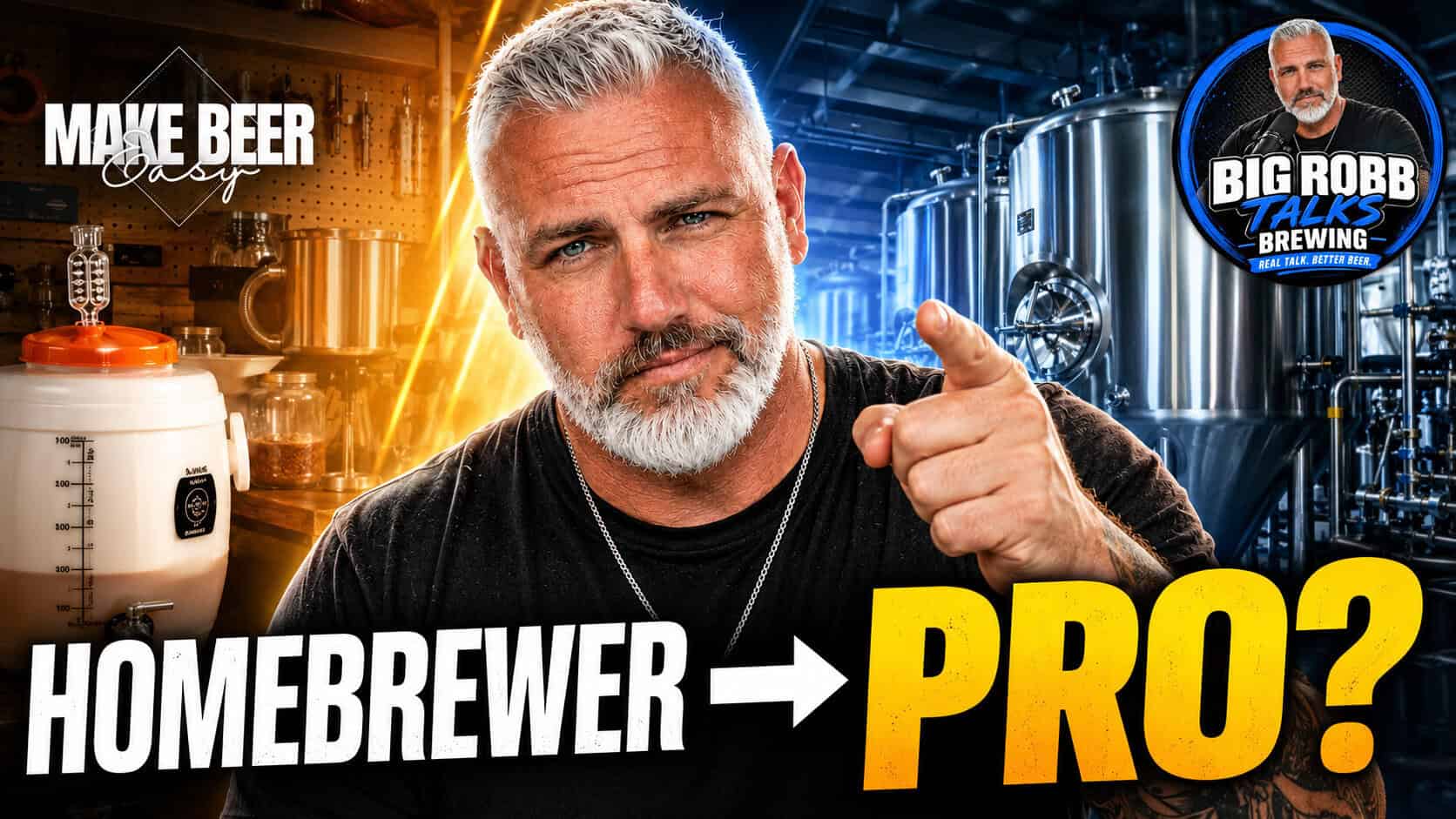
I recently got a comment on one of my YouTube videos that basically said I was “just another homebrewer trying to become a commercial brewer.”
And you know what?
Instead of getting worked up about it, I thought it raised a pretty interesting question.
Can a homebrewer really open a brewery and become a professional brewer?
The short answer is absolutely.
In fact, starting as a homebrewer isn’t some unusual route into professional brewing. It is one of the most common routes into the industry.
The American Homebrewers Association reports that at least 90% of professional brewers began as homebrewers. The AHA also says that most startup breweries are founded by homebrewers. (American Homebrewers Association)
So apparently there are quite a few of us “just another homebrewers” running around out there.
I happen to be one of them.
I started as a homebrewer, eventually opened my own small brewpub, brewed commercially, brought other talented homebrewers in to brew on my system, and learned a pile of lessons along the way.
Here is the video where I got “The Comment”, where I discuss my experience owning a Brew Pub:
“Want the full story of what happened with my brewery?
I recently broke down my entire experience owning and operating Bootstrap Brew Pub—what worked, what didn’t, and why my brewery dream ultimately ended. Watch the full story here!”
So let’s talk about what it actually takes to make that jump—and whether you should.
Can a Homebrewer REALLY Open a Brewery?
Can Homebrewers Become Professional Brewers?
Yes.
Let’s get that out of the way immediately.
Being a homebrewer doesn’t disqualify you from becoming a commercial brewer.
Quite the opposite.
Homebrewing gives you an opportunity to learn the brewing process on a small scale without risking tens or hundreds of thousands of dollars.
You learn:
- Recipe development
- Mashing
- Lautering
- Boiling
- Hop additions
- Yeast management
- Fermentation
- Temperature control
- Water chemistry
- Packaging
- Cleaning and sanitation
- Troubleshooting
- Most importantly, how to make good beer consistently
If you’re still learning the basics, that’s perfectly fine. That’s what homebrewing is for.
My Complete Guide to Homebrewing walks through the brewing process from beginning to end, and my 21 Homebrewing Tips to Make Better Beer will help you start tightening up your process.
The important word there is process.
Because that’s where things start changing when you go commercial.
Homebrewing Is Your Training Ground
At home, you can experiment.
You can screw up a batch.
You can change your recipe halfway through.
You can decide you don’t feel like brewing for three months.
Nobody cares.
When customers are paying for your beer, things change.
Your IPA needs to taste like your IPA every time.
Your blonde ale needs to taste like your blonde ale every time.
You can’t have customers love a beer in June and then wonder what the hell happened to it when they order it again in August.
That’s why I don’t look down on homebrewing as somehow being below commercial brewing.
It’s where you can learn your craft.
Build Your Brewing Setup the Smart Way
If you’re still building your homebrew setup, don’t rush out and buy every shiny piece of equipment you see.
Learn the process first.
Then upgrade the pieces of equipment that actually make your brewing easier, more consistent, or more enjoyable.
👉 Check out the Make Beer Easy Beer Brewing Equipment Hub for the brewing equipment I recommend.
How Many Professional Brewers Started as Homebrewers?
Here’s where that original comment gets really interesting.
According to the American Homebrewers Association:
At least 90% of professional brewers began as homebrewers.
The AHA also says:
- Most professional brewers work for small businesses.
- Most startup breweries are founded by homebrewers.
- Major American craft breweries including Samuel Adams, Sierra Nevada and New Belgium were founded by homebrewers. (American Homebrewers Association)
Think about that for a second.
Nine out of ten.
So the idea that somebody is somehow unqualified to pursue commercial brewing because they started as a homebrewer doesn’t make much sense.
Homebrewing has been one of the industry’s pipelines into professional brewing for decades.
My Own Jump From Homebrewing to Commercial Brewing
That’s exactly how I got there.
I was a homebrewer first.
Eventually, I opened Bootstrap Brew Pub, a small nano-style brewery and taproom.
We weren’t operating some enormous production brewery.
I had two 1-barrel systems along with smaller one-barrel equipment.
And that was intentional.
The idea wasn’t:
Build the biggest brewery possible.
The idea was:
Build something small, inexpensive, community-focused and profitable.
We did the entire thing for somewhere around $60,000.
That included the brewing equipment, furniture and the rest of the setup.
Hence the name Bootstrap Brew Pub.
We were bootstrapping the business.
Homebrewers Became Part of the Brewery
One of my favorite things we did was bring talented local homebrewers into the brewery.
Some of these guys made fantastic beer.
They’d brew on our equipment, bring their friends in, and suddenly somebody was sitting at the bar saying:
“That’s my buddy’s beer up there. Try that one.”
It created community.
And some of those homebrewers eventually went on to professional brewing themselves.
That doesn’t surprise me at all.
It is exactly what you’d expect from a hobby that gives people an opportunity to develop real brewing skills before entering the industry.
Homebrewing vs Commercial Brewing: What’s Actually Different?
Here’s where I don’t want to bullshit you.
Just because you can make great beer at home doesn’t automatically mean you’re ready to run a brewery.
Brewing commercially is a different animal.
1. You Need Consistency
Making one fantastic batch isn’t enough.
You need to be able to make it again.
And again.
And again.
That means learning to control variables instead of hoping everything works out.
Your temperatures, volumes, gravity, yeast health and fermentation all need to become repeatable.
If you’re moving into all-grain brewing, my All Grain Brewing Guide is a good place to tighten up that side of your process.
2. Cleaning and Sanitation Become Even More Important
I’ve always told new brewers that sanitation matters.
Commercially, it becomes absolutely critical.
An infected five-gallon homebrew sucks.
An infected commercial batch can cost you thousands of dollars and damage your reputation.
Your cleaning procedures need to become routines rather than something you remember to do.
Make Beer Easy has a full How to Clean & Sanitize Homebrewing Equipment guide in the Brewing Guides library for exactly this reason. The current Brewing Guides collection includes sanitation, fermentation, water adjustment, all-grain brewing and equipment guides for brewers who want to improve their process. (Make Beer Easy)
3. Fermentation Control Matters
Fermentation is where beer becomes beer.
You can buy beautiful stainless-steel equipment and use the best ingredients available, but poor fermentation can still wreck the finished product.
Temperature control, healthy yeast and proper fermentation practices matter.
That’s why I recommend understanding fermentation temperatures long before you start worrying about opening a brewery.
4. You Eventually Need to Understand Water
This is one of those topics where my advice changes depending on your goal.
If you’re a brand-new homebrewer trying to make your first decent beer, I don’t want you freaking out over water chemistry.
Learn to brew first.
But if you’re trying to make professional-quality beer commercially, you’re going to need to understand your brewing water.
There’s a difference between:
“Do I need advanced water chemistry to enjoy homebrewing?”
and:
“Do I need to understand my water if I’m selling beer professionally?”
For the second question, yes, you should.
The Make Beer Easy Brewing Guides include both How to Adjust Your Brewing Water and my newer Do You Really Need Water Chemistry to Brew Great Beer? guide.
Equipment Won’t Replace Brewing Skill
If you’re moving from basic homebrewing into more serious all-grain brewing, good equipment can absolutely improve repeatability and make brew day easier.
But don’t confuse buying equipment with learning to brew.
Skill first. Equipment second.
When you’re ready to upgrade, check out the Make Beer Easy Beer Brewing Equipment Hub. That’s where I keep the equipment and systems I actually recommend rather than sending you straight to random Amazon listings.
You Don’t Need a Massive Brewery to Start
This is another misconception worth clearing up.
Commercial brewery does not automatically mean enormous stainless tanks and millions of dollars.
Small breweries exist.
Nano breweries exist.
Brewpubs exist.
And creative business models exist.
That was the entire idea behind Bootstrap.
I wasn’t trying to build the next giant regional brewery.
I wanted a small place where people could:
- Drink good beer
- Eat simple food
- Hang out
- Play trivia
- Meet other people
- Try beer brewed by local brewers
- Become part of a community
And it worked.
We had lineups to get in.
The reasons I eventually left the business were more complicated than “the brewery didn’t work.” I had other things happening in my life and ultimately I decided to move on.
But the underlying concept worked.
That’s an important distinction.
The Craft Beer Market Has Changed
Now let’s talk about the part where I throw a little cold water on the dream.
The craft brewing market isn’t what it was during the huge craft-beer boom.
There was a period when it seemed like you could put up a sign saying CRAFT IPA, open the doors and people would show up.
Those days are largely gone.
That doesn’t mean craft beer is dead.
It means the market matured.
And that’s what markets do.
They explode.
Competition moves in.
Consumers get more choices.
The weaker businesses disappear.
The stronger and more interesting ones find their place.
So if you’re thinking about opening a brewery today, “I make good beer” isn’t a complete business plan.
You need to answer a much harder question:
Why should somebody come to YOUR brewery?
What You Need Before Opening a Brewery
If somebody came to me today and said:
“Big Robb, I’m a homebrewer and I want to open a brewery.”
I wouldn’t tell them not to do it.
I’d tell them to get serious about a few things first.
Make Great Beer Consistently
Not one great beer.
Not one competition-winning beer.
You need repeatability.
Brew the same recipe multiple times and see whether you can produce essentially the same beer.
Document everything.
Measure everything.
Fix weaknesses in your process.
Learn More Than One Beer Style
Maybe your IPA is fantastic.
Great.
What else can you brew?
Depending on your business model and local market, customers may expect:
- IPA
- Pale ale
- Blonde ale
- Lager
- Stout
- Seasonal beer
- Specialty beer
You don’t need fifty recipes.
You need a small number of really good ones.
Understand Your Numbers
This is where the romantic brewery dream meets reality.
You need to understand:
- Ingredient costs
- Equipment costs
- Rent or mortgage
- Utilities
- Insurance
- Licensing
- Taxes
- Labor
- Packaging
- Waste
- Maintenance
- Distribution, if applicable
- How much beer you actually need to sell
Brewing is the fun part.
Running a brewery is running a business.
Those are not the same thing.
Research Your Market
Before signing a lease, figure out whether people actually want another brewery where you’re planning to put it.
Look at:
- Population
- Competition
- Tourism
- Local demographics
- Traffic
- Parking
- Nearby restaurants and entertainment
- What existing breweries are doing
- What they’re NOT doing
Sometimes the opportunity isn’t building something bigger.
It’s building something different.
Decide What Kind of Brewery You Actually Want
This is huge.
Do you want:
- A production brewery?
- A nano brewery?
- A neighborhood taproom?
- A brewpub?
- A destination brewery?
- A contract brewing brand?
Those are very different businesses.
Don’t build a $2 million brewery because that’s what you think a “real brewery” is supposed to look like.
Build the business that makes sense for your market, finances and lifestyle.
Should You Work at a Brewery First?
If you have the opportunity, absolutely.
You don’t necessarily need years of professional brewing experience before starting a brewery, but getting inside a working brewery can teach you things homebrewing never will.
You’ll see how much time commercial brewers actually spend:
- Cleaning
- Moving beer
- Cleaning
- Managing inventory
- Cleaning
- Packaging
- Cleaning
- Maintaining equipment
Did I mention cleaning?
You’ll also learn workflow, production scheduling and the reality of brewing when you have to brew, not just when you feel like it.
Can You Scale a Homebrew Recipe to Commercial Size?
Yes, but don’t assume multiplying every ingredient by ten will produce exactly the same beer.
As your system changes, so can:
- Efficiency
- Hop utilization
- Boil-off
- Wort losses
- Fermentation performance
- Yeast requirements
- Water chemistry
- Heat transfer
Your homebrew recipe can absolutely be the foundation.
But you’ll need to dial it into the commercial system.
That’s another reason learning to take good brewing notes matters.
Should You Go to Brewing School?
You don’t have to have a brewing degree to become a professional brewer.
Plenty of professional brewers learned through:
- Homebrewing
- Working in breweries
- Apprenticeship-style experience
- Brewing courses
- Books
- Clubs and competitions
- Trial and error
Formal education can absolutely help, especially if you’re aiming for larger production breweries or technical brewing positions.
But there’s no single path.
The key is competency.
Can you understand the process?
Can you diagnose problems?
Can you produce consistent beer?
Can you safely operate the equipment?
Can you continue learning?
That’s what matters.
Is Opening a Brewery Still Worth It?
That’s a completely different question from whether a homebrewer can do it.
Can you?
Absolutely.
Should you?
Depends.
If you love brewing but hate:
- Managing employees
- Dealing with customers
- Bookkeeping
- Regulations
- Sales
- Marketing
- Long hours
- Financial risk
then you might discover that you preferred homebrewing.
And there’s nothing wrong with that.
Turning something you love into a business changes your relationship with it.
I know that firsthand.
Today, I’m enjoying what I do with Make Beer Easy. I get to brew, experiment, teach, make videos and talk beer without being tied to a bricks-and-mortar brewery every day.
Would I ever open another brewery?
Never say never.
But I’m pretty happy doing this.
The Best First Step If You Want to Go Pro
Start brewing.
Seriously.
Don’t begin by shopping for a 10-barrel brewhouse.
Start by becoming a damn good brewer.
If you’re brand new, learn the fundamentals.
Make a batch.
Take notes.
Make another.
Improve it.
Then make another.
If you eventually decide commercial brewing is where you want to go, you’ll have built the most important foundation first:
You know how to make beer.
Equipment Used
You don’t need commercial equipment to start learning the skills that could eventually take you into professional brewing.
For serious homebrewing, I’d focus first on:
- A reliable brewing system or kettle
- Fermenters
- Accurate thermometer
- Hydrometer or refractometer
Looking for the measuring and testing gear I recommend?
👉 See My Measuring & Testing Equipment - Fermentation temperature control
- Proper cleaning and sanitizing equipment
- Bottling or kegging equipment
- Good brewing software or brewing notes
👉 See the brewing equipment I personally recommend in the Make Beer Easy Beer Brewing Equipment Hub.
That’s where I organize my equipment recommendations rather than sending you directly to Amazon.
Continue Learning
If you’re serious about improving your brewing before even thinking about going commercial, these Make Beer Easy guides are good next steps:
Start with the Complete Guide to Homebrewing if you want to tighten up your overall process.
When you’re ready to move deeper into brewing from grain, use my All Grain Brewing Guide.
Then work through the Brewing Guides covering:
- Fermentation Temperatures in Homebrewing Beer
- How to Clean & Sanitize Homebrewing Equipment
- How to Adjust Your Brewing Water
- Equipment Needed to Brew Beer
- 21 Homebrewing Tips
All of those guides are currently part of the Make Beer Easy Brewing Guides library. (Make Beer Easy)
FREE Beginner Homebrewing Bootcamp
If you’re reading this thinking:
“Forget the brewery for now, Big Robb. I just want to learn how to make good beer.”
Perfect.
That’s exactly where you should start.
I’ve put together a FREE 7-Day Beginner Brewing Bootcamp that walks you through the fundamentals in plain English without making homebrewing more complicated than it needs to be.
👉 Join the FREE Beginner Brewing Bootcamp
Start the Beginner Brewing Bootcamp
Get My Top 5 Best-Selling Brew Pub Recipes
Want to brew some of the beers that actually came out of my own brewpub experience?
I’ve put together my Top 5 Best-Selling Brew Pub Recipes and you can grab them completely free.
These aren’t recipes I pulled off the internet.
They’re recipes from my brewing journey and brewpub.
👉 Get My Top 5 Best-Selling Brew Pub Recipes
Frequently Asked Questions
Can a homebrewer become a professional brewer?
Absolutely. The American Homebrewers Association reports that at least 90% of professional brewers began as homebrewers. (American Homebrewers Association)
Homebrewing gives you an inexpensive environment to learn recipe development, fermentation, sanitation, troubleshooting and the fundamentals of brewing before moving onto commercial equipment.
Do most professional brewers start as homebrewers?
According to the American Homebrewers Association, at least 90% do. The AHA also states that most startup breweries are founded by homebrewers.
Do I need professional brewing experience before opening a brewery?
Not necessarily, but professional brewery experience can be extremely valuable.
Making beer is only one part of operating a brewery. Production scheduling, cleaning, equipment maintenance, inventory, staffing, regulations, sales and financial management all become part of the job.
Do I need a brewing degree to open a brewery?
No.
Formal brewing education can be valuable, but it isn’t the only path into professional brewing. Many commercial brewers developed their skills through homebrewing and hands-on brewery experience.
Can I use my homebrew recipes commercially?
Your homebrew recipes can certainly become the starting point for commercial recipes.
However, recipes usually need to be adjusted when moving onto a larger brewing system because efficiency, hop utilization, losses and fermentation conditions can change.
How good should my beer be before I open a brewery?
Good enough that you can make it consistently.
Don’t judge yourself by your single greatest batch.
Ask whether you can brew that beer repeatedly and produce essentially the same result.
That’s a much better test of whether your brewing process is becoming professional.
Is opening a nano brewery easier than opening a large brewery?
It’s usually less capital intensive, but that doesn’t necessarily mean it’s easy.
Small breweries still have licensing, equipment, rent, utilities, labor and operating costs. The advantage is that a smaller model can potentially reduce your initial investment and allow you to serve a smaller local market.
Is the craft brewery market too crowded?
That depends heavily on your location.
Some markets are saturated. Others still have opportunities.
That’s why market research matters. Don’t simply count breweries. Look at population, tourism, competition, customer demand and whether your concept offers something different.
Should I turn my homebrewing hobby into a business?
Only if you want the business part too.
If you only love brewing beer, keeping it as a hobby may be the better choice.
If you enjoy brewing and you’re interested in building a business, serving customers, marketing, managing costs and creating a community, commercial brewing may be worth exploring.
Conclusion
So, can a homebrewer really open a brewery?
Hell yes.
Homebrewing isn’t some mark against becoming a professional brewer.
For a huge percentage of professional brewers, it’s where the journey started.
But don’t misunderstand what I’m saying.
Being a good homebrewer doesn’t automatically make you a good brewery owner.
Use homebrewing as your laboratory.
Learn your process.
Dial in your recipes.
Understand fermentation.
Learn water chemistry when you’re ready for it.
Make your beer consistently.
And if you eventually decide you want to take the commercial leap, do your market research and treat the brewery like what it really is:
A business that happens to make beer.
If it’s your dream, don’t let somebody on the internet tell you you’re “just a homebrewer.”
Every professional brewer had to start somewhere.
Cheers,
Big Robb
Make Beer Easy
Simple Brewing. Better Beer. Made Easy.
Leave a Comment
Have you ever thought about turning your homebrewing hobby into a commercial brewery?
Or maybe you’ve already made the jump.
Drop a comment below and tell me about it.
And if you think I’m completely out to lunch, tell me that too.
Apparently those comments give me ideas for new videos. 🍻