
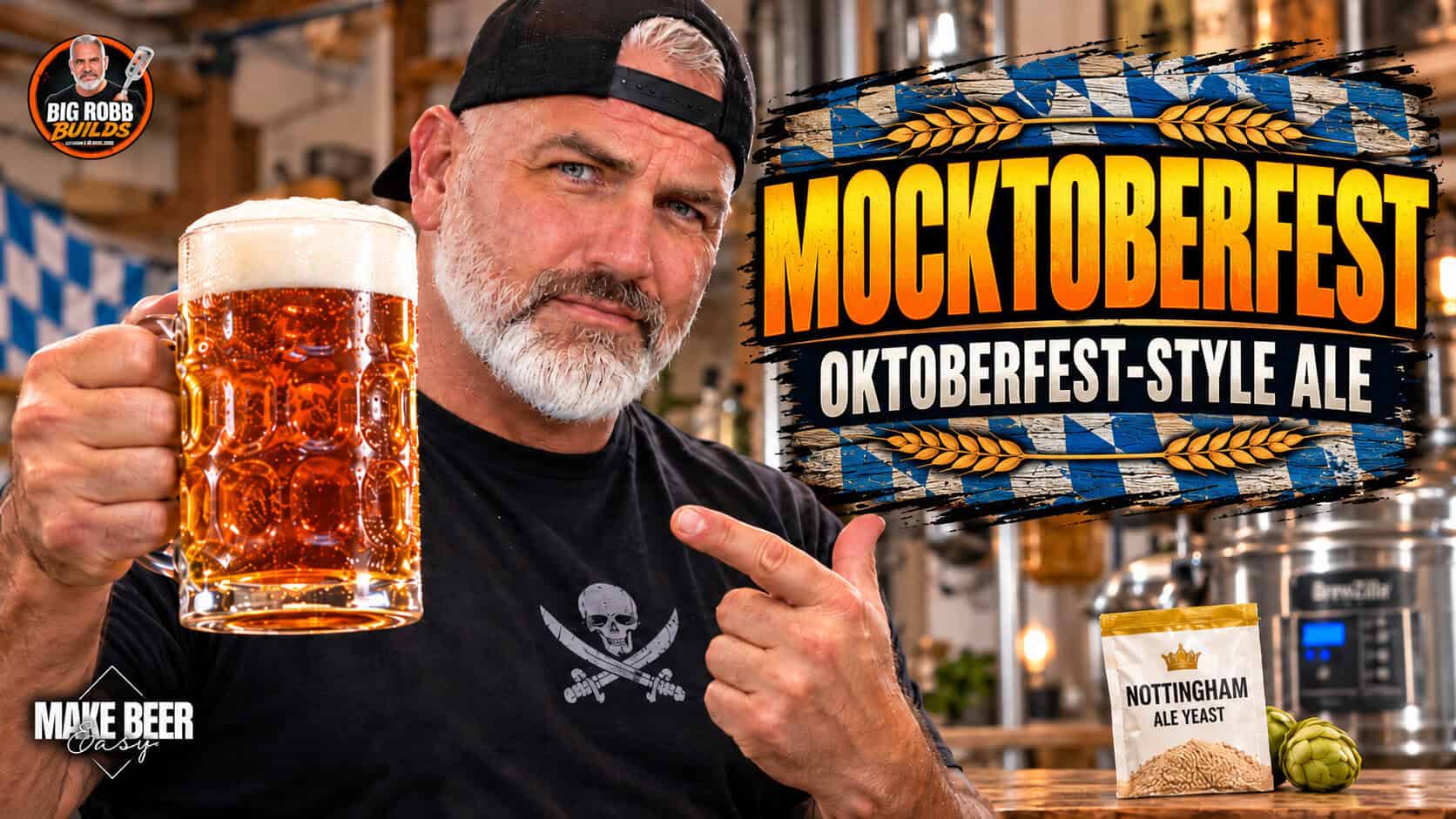
October rolls around and Oktoberfest beer starts sounding pretty damn good.
Rich malt.
Fresh bread.
A little toast.
That beautiful copper color.
Enough bitterness to balance everything without turning it into a hop bomb.
The only problem?
A traditional Märzen is a lager, and not every homebrewer wants to mess around with a full lager fermentation schedule.
So I decided to cheat a little.
Meet Mocktoberfest.
This is my Oktoberfest-inspired ale brewed with Munich, Vienna and Pilsner malt, Hallertau Mittelfrüh hops and Nottingham ale yeast fermented on the cool side.
Is it technically a traditional Märzen?
No.
That’s the whole point of the name.
But if you want a malty Oktoberfest-style beer without doing a traditional lager fermentation, this recipe will get you pretty damn close to the character we’re after while keeping the process simple.
Simple brewing. Better beer.
Mocktoberfest Recipe at a Glance
Batch Size: 5.5 gallons into the fermenter
Finished Beer: Approximately 5 gallons packaged
Brewhouse Efficiency: 70%
Boil Time: 60 minutes
Estimated OG: 1.057
Estimated FG: 1.013
Estimated ABV: 5.74%
Estimated IBU: 24.8
Estimated SRM: 8.33
These numbers were checked using Brewer’s Friend with the malt, yeast attenuation and hop alpha-acid assumptions used in this recipe.
Your numbers can move slightly depending on your malt specifications, actual hop alpha acids, brewing efficiency and fermentation performance.
Mocktoberfest Grain Bill
For a 5.5-gallon batch:
Fermentables
4 lb Weyermann Munich Malt Type I
3 lb Weyermann Munich Malt Type II
3 lb Weyermann Vienna Malt
2 lb Weyermann Pilsner Malt
Total Grain: 12 lb
There is intentionally no crystal or caramel malt in this recipe.
I want the malt flavor to come from the Munich and Vienna malts rather than trying to manufacture maltiness by dumping a pile of crystal malt into the recipe.
Grain Percentages
Munich Type I – 33.3%
Munich Type II – 25%
Vienna – 25%
Pilsner – 16.7%
That means more than half of the grain bill is Munich malt.
That’s where we’re going to get most of the deep bread, malt and light toast character.
The Vienna adds another layer of breadiness while keeping things from getting too heavy, and the Pilsner malt lightens the overall grain bill.
Do You Have to Use Weyermann Malt?
No.
Weyermann is simply the German maltster whose malt specifications were used when I calculated this particular recipe.
If your homebrew shop carries another reputable brand of Munich, Vienna or Pilsner malt, you can absolutely use it.
Just understand that different maltsters can have slightly different:
- extract potential
- color
- moisture
- flavor
That means your OG and SRM might move slightly.
If you substitute malt brands, enter the actual malt you’re using into your brewing calculator and see what happens to the recipe.
Don’t blindly assume every malt with the same name has identical specifications.
If you ever need to replace a malt, hop or yeast because your homebrew shop doesn’t have exactly what the recipe calls for, check out my guide on how to substitute hops, grain and yeast without screwing up your beer.
Mocktoberfest Hop Schedule
We’re keeping the hops simple.
Hallertau Mittelfrüh
For this recipe I’m assuming:
4% alpha acid
60 Minutes
1.5 oz Hallertau Mittelfrüh
This provides the majority of our bitterness.
20 Minutes
0.5 oz Hallertau Mittelfrüh
This adds a little more bitterness along with some of that traditional mild herbal, floral and spicy noble-hop character.
That’s it.
No whirlpool addition.
No dry hop.
This isn’t supposed to smell like somebody dropped an IPA into Oktoberfest.
Let the malt do the talking.
Important: Check Your Hop Alpha Acids
The 24.8 IBU estimate assumes 4% alpha acid Hallertau Mittelfrüh.
Look at the package you actually buy.
If yours is 3%, 3.5%, 4.5% or something else, enter that number into your brewing software and recalculate the recipe.
Hop alpha acids matter.
Don’t copy somebody’s hop weight while ignoring the alpha-acid percentage and then wonder why your bitterness doesn’t match.
Yeast – Nottingham Ale Yeast
This is what makes Mocktoberfest a Mocktoberfest.
We’re using:
1 × 11 g Packet Nottingham Ale Yeast
A lot of longtime homebrewers still know this yeast as Danstar Nottingham. Today you’ll normally see it sold as LalBrew Nottingham by Lallemand.
Nottingham works extremely well for this beer because it can ferment clean when you keep it on the cooler side.
We don’t want a pile of fruity ale esters competing with the Munich malt.
We want the fermentation profile restrained.
Brewer’s Friend Attenuation
For this recipe we’re using approximately:
77% apparent attenuation
That’s why Brewer’s Friend predicts:
OG 1.057 → FG 1.013
giving us approximately:
5.74% ABV
Real yeast does not read Brewer’s Friend before going to work, so don’t panic if your final gravity lands a point or two away.
The important thing is that fermentation finishes and gravity becomes stable.
Mash Schedule
Mash the grain at:
152°F for 60 Minutes
This is a good middle ground for Mocktoberfest.
We’re looking for enough fermentability that the beer doesn’t finish heavy and syrupy while retaining enough body to support the malt character.
I brew on a BrewZilla all-in-one brewing system, so I recirculate during the mash.
If you’re brewing BIAB or using another all-grain system, you can still brew this recipe.
The important part is maintaining approximately 152°F during the mash.
If you’re just getting into all-grain brewing, my complete all-grain brewing instructions will walk you through the entire process.
Optional Mash Out
If you normally perform a mash out, raise the mash to approximately:
168–170°F for around 10 minutes
before removing the grain.
It’s optional.
Don’t convince yourself your beer is ruined because you skipped a mash out.
If you’re wondering whether you actually need to do one, read my full guide on what a mash out is and whether it’s worth doing.
Sparging the Mocktoberfest
After the mash, I lift the malt pipe on the BrewZilla and sparge over the grain bed.
I’m looking for approximately:
7 Gallons Pre-Boil
I don’t normally measure out some magical exact sparge-water quantity beforehand.
I sparge until I reach the pre-boil volume I’m looking for.
Your system might require a little more or less water depending on:
- grain absorption
- dead space
- boil-off rate
- equipment losses
- your brewing system
Know your equipment.
If you’re still trying to understand the different sparging methods and what we’re actually accomplishing by rinsing the grain, read my guide on what sparging is and how to do it.
The Boil
Boil for:
60 Minutes
At 60 Minutes Remaining
Add:
1.5 oz Hallertau Mittelfrüh
At 20 Minutes Remaining
Add:
0.5 oz Hallertau Mittelfrüh
At the end of the boil I’m expecting approximately:
6 Gallons of Wort Remaining
After chilling and leaving behind kettle trub and hop material, the goal is:
5.5 Gallons Into the Fermenter
That part matters.
This recipe is not designed for 5.5 gallons packaged.
We’re putting approximately 5.5 gallons into the fermenter so that after fermentation, yeast sediment and transfer losses we finish with roughly:
5 Gallons in the Keg or Bottles
Brewing Mocktoberfest on a BrewZilla
This recipe works extremely well on an electric all-in-one brewing system.
My basic process is:
Mash.
Recirculate.
Lift the malt pipe.
Sparge to pre-boil volume.
Boil.
Chill.
Ferment.
Nothing complicated.
I use a BrewZilla, but you absolutely don’t need the exact same brewing system I use.
If you’re moving into electric all-grain brewing or you’re trying to decide what equipment actually makes sense, check out my All-Grain Brewing Equipment Guide.
That’s where I keep my recommendations for BrewZilla systems, BIAB equipment, grain mills, wort chillers and other all-grain brewing gear.
And if you’ve already got the main brewing system but need the smaller stuff that makes brew day easier, check out my Brew Day Equipment & Accessories Guide.
You’ll find my recommendations for mash paddles, hop spiders, wort chillers, heat-resistant gloves and other useful brew-day gear.
Affiliate Disclosure
Some of the equipment recommendations on Make Beer Easy contain affiliate links. As an Amazon Associate I earn from qualifying purchases at no additional cost to you.
If you’re looking for equipment beyond this specific recipe, you can find everything organized in the Make Beer Easy Recommended Brewing Equipment Hub.
Chill the Wort
After the boil, chill the wort down to approximately:
60°F
Then transfer:
5.5 Gallons
into a properly cleaned and sanitized fermenter.
At this point anything touching the wort needs to be properly sanitized.
Clean and sanitized are not the same thing.
Cleaner removes the crud.
Sanitizer deals with microorganisms on equipment that is already clean.
If you’re getting your brewery set up or need cleaners, sanitizer, brushes or other cleaning gear, check out my Cleaning & Sanitation Equipment Guide.
Fermenting Mocktoberfest
Pitch:
1 packet Nottingham Ale Yeast
at approximately:
60°F
Then hold fermentation around:
60–62°F
during the main part of fermentation.
This cooler fermentation temperature is one of the most important parts of the recipe.
We’re intentionally trying to keep Nottingham restrained so the finished beer drinks cleaner than a warmer-fermented ale.
As fermentation begins slowing down, allow the beer to rise to approximately:
64–66°F
This gives the yeast a chance to finish fermentation and clean things up.
Fermentation Temperature Control Matters
This is one recipe where fermentation temperature control really earns its keep.
If the room where you’re fermenting swings from 58°F overnight to 75°F during the day, you’re not really controlling the temperature the yeast is experiencing.
Active fermentation can also generate its own heat, meaning your fermenting beer can be warmer than the room around it.
A simple refrigerator or freezer paired with an Inkbird-style temperature controller can make fermentation considerably more predictable.
If you need a fermenter, temperature controller, fermentation chamber, heating equipment or cooling setup, I’ve put my recommendations in the Fermentation & Temperature Control Equipment Guide.
For Mocktoberfest, keeping Nottingham cool is one of the keys to getting the clean character we’re looking for.
How Long Should Mocktoberfest Ferment?
I’m sticking with my normal rule:
Give It Approximately 14 Days
Don’t spend two weeks opening the fermenter every twelve hours because you want to see what the yeast is doing.
Leave the damn thing alone.
Around Day 14, take a hydrometer reading.
Our estimated final gravity is:
1.013
If fermentation is finished and the gravity is stable, we can move on.
If hydrometers still seem like some strange science experiment, read my guide on how to read and use a hydrometer.
And if you need a hydrometer, test jar, thermometer, scale, refractometer or pH meter, I’ve put my recommendations in the Measuring & Testing Equipment Guide.
A hydrometer is still one of the first pieces of measuring equipment I’d recommend to a homebrewer.
An airlock doesn’t tell you when fermentation is finished.
Gravity does.
Cold Crashing and Cold Conditioning
Once fermentation is finished, I recommend cold crashing Mocktoberfest.
Bring the beer down into approximately:
34–36°F
Cold crashing encourages yeast and other material to drop out of suspension.
For this particular beer, clarity fits the character we’re trying to create.
You can package it after the cold crash, but if you’ve got the time and cold-storage space, I’d give it another:
1–2 Weeks Cold
before packaging or serving.
Is that technically lagering?
No.
We’re cold-conditioning an ale.
We’re simply giving the beer some extra cold time to help it clear and smooth out.
Patience usually improves beer.
Should You Use Gelatin?
You can.
But you don’t have to.
If the beer is still hazier than you want after cold crashing, gelatin can help produce a bright, clear pint.
Wait until fermentation is completely finished and get the beer cold first.
I walk through the entire process in my guide on how to gelatin fine beer.
Don’t throw gelatin into actively fermenting beer and expect magic.
Let the yeast finish its job first.
Packaging Mocktoberfest
After fermentation and conditioning we’re looking for approximately:
5 Gallons of Finished Beer
from the original:
5.5 Gallons in the Fermenter
You can keg it or bottle it.
Carbonation Target
Aim for approximately:
2.4–2.5 Volumes of CO₂
That’s enough carbonation to keep the beer lively and refreshing without turning it into fizzy water.
If you’re not sure how to dial in carbonation for either bottles or kegs, read my complete guide on how to carbonate beer.
Kegging Mocktoberfest
If you’re kegging, transfer the beer carefully and try to minimize unnecessary oxygen exposure.
Kegging is definitely my preferred way to package most five-gallon batches.
If you’re thinking about making the jump to draft beer at home, check out my Kegging & Kegerator Equipment Guide.
That’s where I keep my recommendations for:
- Cornelius kegs
- CO₂ tanks
- regulators
- gas and beer lines
- disconnects
- faucets
- picnic taps
- temperature control
- kegerator equipment
You don’t need all of it on Day One.
Build the system you actually need.
Bottling Mocktoberfest
Bottling works perfectly well too.
If you’re bottle conditioning, make sure fermentation is completely finished before adding your priming sugar or carbonation drops.
Don’t guess.
That’s what the hydrometer is for.
If you want to understand the entire process, read my Guide to Bottle Conditioning Beer.
And if you need bottles, caps, cappers, bottling wands, bottling buckets, carbonation drops or other packaging gear, check out my Bottling & Packaging Equipment Guide.
Mocktoberfest Ingredient Substitutions
One missing ingredient doesn’t have to cancel brew day.
But understand what you’re changing.
Munich Malt
If you can’t get Weyermann Munich Type I or Type II, similar Munich malts from another quality maltster can work.
Enter the actual malt into your brewing software because color and extract potential may change.
Vienna Malt
Another quality Vienna malt is fine.
Again, check the actual specifications.
Pilsner Malt
Any good-quality Pilsner base malt should work.
Hallertau Mittelfrüh
If Mittelfrüh isn’t available, another traditional German or continental noble-style hop can work.
But don’t blindly swap hops ounce-for-ounce.
Check the alpha acids and recalculate your IBUs.
Nottingham Yeast
Nottingham is a major part of this particular recipe.
You can use another clean ale yeast, but you’re no longer brewing exactly the same Mocktoberfest recipe.
Different yeast can change:
- attenuation
- final gravity
- ABV
- fermentation temperature
- flavor profile
Run the recipe through your brewing software again.
For a deeper explanation of making intelligent substitutions, read Don’t Cancel Brew Day: How to Substitute Hops, Grain and Yeast.
Mocktoberfest Recipe Card
Batch Size
5.5 gallons into the fermenter
Approximately 5 gallons packaged
Fermentables
4 lb Weyermann Munich Malt Type I
3 lb Weyermann Munich Malt Type II
3 lb Weyermann Vienna Malt
2 lb Weyermann Pilsner Malt
Total Grain: 12 lb
Hops
Assuming 4% AA Hallertau Mittelfrüh
1.5 oz – 60 minutes
0.5 oz – 20 minutes
Yeast
1 × 11 g Nottingham Ale Yeast
Mash
152°F – 60 minutes
Optional:
168–170°F mash out – approximately 10 minutes
Boil
60 minutes
Pre-Boil Volume
Approximately:
7.1 gallons
Fermenter Volume
5.5 gallons
Fermentation
Pitch around:
60°F
Main fermentation:
60–62°F
Allow to rise toward completion:
64–66°F
Check final gravity around:
Day 14
Cold Conditioning
Cold crash:
34–36°F
Optional additional cold-conditioning time:
1–2 weeks
Packaging
Approximately:
5 gallons
Carbonation:
2.4–2.5 volumes CO₂
Brewer’s Friend Estimates
OG: 1.057
FG: 1.013
ABV: 5.74%
IBU: 24.8
SRM: 8.33
Brewhouse Efficiency: 70%
Mocktoberfest FAQ
Is Mocktoberfest a Real Märzen?
No.
A traditional Märzen is a lager.
Mocktoberfest is deliberately fermented with an ale yeast, which is why I’m calling it Mocktoberfest instead of pretending it’s something it isn’t.
The grain bill, noble hops, malt-forward balance and overall presentation are inspired by traditional Oktoberfest-style beer.
Why Use Nottingham?
Because Nottingham can ferment relatively clean when kept cool while still giving us the simplicity of ale fermentation.
That makes it a good choice when we’re trying to create a lager-inspired beer without actually using lager yeast.
Can I Ferment Nottingham Warmer?
You can.
But that’s not how I would brew this recipe.
Warmer ale fermentations can produce more fermentation character.
For Mocktoberfest, I want the malt character up front.
Keep it cool.
Do I Have to Cold Condition the Beer?
No.
Once fermentation is complete, you can package it.
But this is one of those beers where some extra cold time can really help the finished product.
If you’ve got the time, use it.
Can I Use Lager Yeast Instead?
Sure.
But then you’re moving away from the whole reason I created Mocktoberfest.
At that point you’re brewing something much closer to an actual Märzen and should build your fermentation schedule accordingly.
Why Is the IBU 24.8?
That’s the estimate Brewer’s Friend gives this recipe using Hallertau Mittelfrüh at 4% alpha acid.
It’s a little firmer than the traditional upper end for a classic Märzen.
I’m okay with it.
This isn’t being presented as a strict competition Märzen.
If you’d prefer softer bitterness, reduce the bittering addition and recalculate the recipe using the actual alpha-acid percentage of the hops you’re using.
Can I Brew Mocktoberfest With BIAB?
Absolutely.
The recipe isn’t dependent on the BrewZilla.
Use the same grain bill, mash temperature and hop schedule and adjust the water volumes and efficiency for your own system.
If you’ve never brewed BIAB before, start with my guide on How to Brew in a Bag.
Recommended Equipment for Brewing Mocktoberfest
You don’t need to buy a whole new brewery for one recipe.
But if you’re building or upgrading your setup, these are the equipment guides most relevant to Mocktoberfest:
👉 All-Grain Brewing Equipment — BrewZilla systems, BIAB gear, mills, chillers and complete all-grain setups.
👉 Brew Day Equipment & Accessories — paddles, hop spiders, chillers, brewing gloves and other brew-day gear.
👉 Fermentation & Temperature Control Equipment — fermenters, Inkbird controllers, fermentation chambers and heating/cooling equipment.
👉 Measuring & Testing Equipment — hydrometers, thermometers, scales, refractometers and pH meters.
👉 Cleaning & Sanitation Equipment — cleaners, Star San and other sanitation equipment.
👉 Kegging & Kegerator Equipment — kegs, CO₂ systems, regulators and draft equipment.
👉 Bottling & Packaging Equipment — bottles, cappers, bottling wands, carbonation drops and packaging gear.
Or start at the Make Beer Easy Recommended Brewing Equipment Hub and find the equipment category you need.
Affiliate Disclosure: Some equipment recommendations on Make Beer Easy contain affiliate links. As an Amazon Associate I earn from qualifying purchases at no additional cost to you.
Want More Brewing Help and Recipes?
If you’re newer to homebrewing and want me to walk you through the fundamentals without making this hobby more complicated than it needs to be:
👉 Join the Beginner Brewer Bootcamp
You’ll get beginner-friendly brewing lessons delivered to your inbox to help you understand the process and make better beer.
And if you’re looking for more recipes:
👉 Get My Top 5 Best-Selling Brew Pub Recipes
These are beers that became customer favorites at my own brewpub, and I’ll send the collection to you as a gift.
Grab both and keep brewing.
Final Thoughts on Mocktoberfest
This is what Make Beer Easy is all about.
You don’t always have to brew something exactly the way it’s traditionally been done.
Understand what you’re changing.
Understand why you’re changing it.
Then make some damn beer.
Mocktoberfest keeps the parts of Oktoberfest beer I really want:
Rich Munich malt.
Bread.
Toast.
Copper color.
Noble hops.
A balanced finish.
But instead of using lager yeast and doing a full traditional lager fermentation, we’re using Nottingham ale yeast and keeping it cool.
Will a German brewmaster kick down my door and confiscate my brewing equipment?
Probably not.
And if he does, I’ll give him a pint.
Cheers,
Big Robb
Make Beer Easy
Simple brewing. Better beer.